
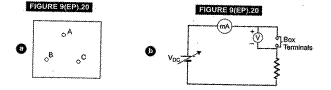
 Three components namely, two germanium diodes and one
resistor are connected across these three terminals in some arrangement. A
student performs an experiment in which any two of these three terminals are
connected in the circuit shown in Fig. 9(EP),20 (b). The student obtains graphs
of current-voltage characteristics for unknown combination of components between
the two terminals connected in the circuit. The graphs are
(i) When Aa si positive and B is negative
Three components namely, two germanium diodes and one
resistor are connected across these three terminals in some arrangement. A
student performs an experiment in which any two of these three terminals are
connected in the circuit shown in Fig. 9(EP),20 (b). The student obtains graphs
of current-voltage characteristics for unknown combination of components between
the two terminals connected in the circuit. The graphs are
(i) When Aa si positive and B is negative
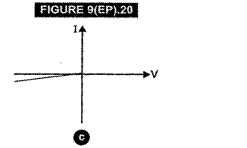 (ii) When A is
negative and B is positive
(ii) When A is
negative and B is positive
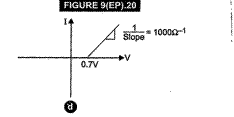 (iii) When B is negative and C is positive
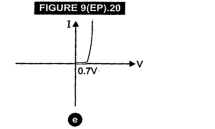 (iv) When B is
positive and C is negative
(iv) When B is
positive and C is negative
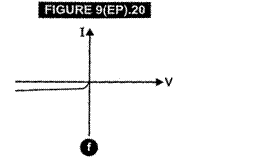 (v) When A is positive
and C is negative
(v) When A is positive
and C is negative
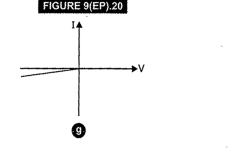 (vi) When A is
negative and C is positive
(vi) When A is
negative and C is positive
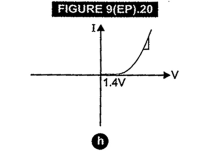 From these graphs of current - voltage characteristic
shown in Fig. 9(EP).20 (c) to (h), determine the arrangement of components
between A, B and C.
From these graphs of current - voltage characteristic
shown in Fig. 9(EP).20 (c) to (h), determine the arrangement of components
between A, B and C.
Answer:
(a) In V- graph of condition (i), a
reverse characteristics is shown in Fig. 9(EP).20(c). Here A is connected to
n-side of p-n junction I and B is connected to p-side of p-n junction with
a resistance in series.
(b) In V-l graph of condition (ii), a forward
characteristics is shown in Fig. 9(EP).20(d), where 0-7 V is the knee voltage
of p-n junction and 1/slope=(1/1000)
graph of condition (i), a
reverse characteristics is shown in Fig. 9(EP).20(c). Here A is connected to
n-side of p-n junction I and B is connected to p-side of p-n junction with
a resistance in series.
(b) In V-l graph of condition (ii), a forward
characteristics is shown in Fig. 9(EP).20(d), where 0-7 V is the knee voltage
of p-n junction and 1/slope=(1/1000)  It means A is connected to n-side of p-n junction and resistance -R is in series
of p-n junction I between A and B.
(c) In V- graph of
condition (iii), a forward characteristics is shown in Fig. 9(EP).20(e), where
0.7 V is the knee voltage. In this case p-side of p-n junction-n is connected
to C and n-side of p-n junction II to B.
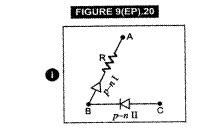
(d) In V- graphs of
conditions (iv), (v) and (vi) also concludes the above connections of p-n
junctions I and n along with a resistance R. Thus, the arrangement of p-n , p-n
It means A is connected to n-side of p-n junction and resistance -R is in series
of p-n junction I between A and B.
(c) In V- graph of
condition (iii), a forward characteristics is shown in Fig. 9(EP).20(e), where
0.7 V is the knee voltage. In this case p-side of p-n junction-n is connected
to C and n-side of p-n junction II to B.
(d) In V- graphs of
conditions (iv), (v) and (vi) also concludes the above connections of p-n
junctions I and n along with a resistance R. Thus, the arrangement of p-n , p-n  and resistance R between A, B
and C will be as shown in Fig. 9(EP).20(i).
and resistance R between A, B
and C will be as shown in Fig. 9(EP).20(i).






You need to login to perform this action.
You will be redirected in
3 sec