
| Column I (Complex) | Column II (Hybridisation) | ||
| (I) | \[{{[Au{{F}_{4}}]}^{-}}\] | (P) | \[ds{{p}^{2}}\]hybridisation |
| (II) | \[{{[Cu{{(CN)}_{4}}]}^{3-}}\] | (Q) | \[ds{{p}^{3}}\]hybridisation |
| (III) | \[{{[Cu{{({{C}_{2}}{{O}_{4}})}_{3}}]}^{3-}}\] | (R) | \[s{{p}^{3}}\,{{d}^{2}}\]hybridisation |
| (IV) | \[{{[Fe{{({{H}_{2}}O)}_{5}}NO]}^{2+}}\] | (S) | \[{{d}^{2}}s{{p}^{3}}\]hybridisation |
A) (I)\[\to \]Q, (II)\[\to \]P, (III)\[\to \]R, (IV)\[\to \]S
B) (I)\[\to \]P, (II)\[\to \]Q, (III)\[\to \]S, (IV)\[\to \]R
C) (I)\[\to \]P, (II)\[\to \]Q, (III)\[\to \]R, (IV)\[\to \]S
D) (I)\[\to \]Q, (II)\[\to \]P, (III)\[\to \]S, (IV)\[\to \]R
Correct Answer: B
Solution :
| [b] |
| (I) Au in +3 oxidation state with \[5{{d}^{8}}\]configuration has higher CFSE. So complex has \[ds{{p}^{2}}\]hybridisation and is diamagnetic. |
| (II) Cu is in +1 oxidation state with \[3{{d}^{10}}\]configuration and no \[\left( n-1 \right)d\] orbital is available for \[ds{{p}^{2}}\] hybridisation and complex is diamagnetic. |
| (III) Co is in +3 oxidation state and \[3{{d}^{6}}\]configuration has higher CFSE. So complex is diamagnetic and has \[{{d}^{2}}s{{p}^{3}}\]hybridisation. |
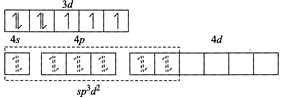
| (IV) Fe is in +1 oxidation state and the complex is paramagnetic with three unpaired electrons. |
| \[{{[Fe{{({{H}_{2}}O)}_{5}}NO]}^{2+}};\] |






You need to login to perform this action.
You will be redirected in
3 sec