
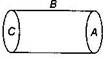
| A hollow cylinder has a charge q coulomb within it. If \[\phi \] is the electric flux in unit of voltmeter associated with the curved surface B, the flux linked with the plane surface A in unit of voltmeter will be : [AIPMT (S) 2007] |
 |
A) \[\frac{1}{2}\left( \frac{q}{{{\varepsilon }_{0}}}-\phi \right)\]
B) \[\frac{q}{2\,{{\varepsilon }_{0}}}\]
C) \[\frac{\phi }{3}\]
D) \[\frac{q}{{{\varepsilon }_{0}}}-\phi \]
Correct Answer: A
Solution :
| [a] Key Idea: Apply Gauss's law to calculate the charge associated with plane surface A. |
| Gauss's law states that the net electric flux through any closed surface is equal to the net charge inside the surface divided by \[{{\varepsilon }_{0}}\]. That is |
| i.e., \[{{\phi }_{total}}=\frac{q}{{{\varepsilon }_{0}}}\] |
| Let electric flux linked with surfaces, A, B and C are \[{{\phi }_{A}},{{\phi }_{B}}\] and \[{{\phi }_{C}}\] respectively. That is |
| \[{{\phi }_{total}}={{\phi }_{A}}+{{\phi }_{B}}+{{\phi }_{C}}\] |
| Since, \[{{\phi }_{C}}={{\phi }_{A}}\] |
| \[\therefore \] \[2{{\phi }_{A}}+{{\phi }_{B}}={{\phi }_{total}}=\frac{q}{{{\varepsilon }_{0}}}\] |
| or \[{{\phi }_{A}}=\frac{1}{2}\left( \frac{q}{{{\varepsilon }_{0}}}-{{\phi }_{B}} \right)\] |
| But \[{{\phi }_{B}}=\phi \,(given)\] |
| Hence, \[{{\phi }_{A}}=\frac{1}{2}\left( \frac{q}{{{\varepsilon }_{0}}}-\phi \right)\] |






You need to login to perform this action.
You will be redirected in
3 sec