
A) \[{{\text{v}}_{\text{A}}}\text{=}{{\text{v}}_{\text{B}}}\text{=}{{\text{v}}_{\text{C}}}\]
B) \[{{\text{v}}_{\text{A}}}\text{=}{{\text{v}}_{\text{B}}}\text{}{{\text{v}}_{\text{C}}}\]
C) \[{{\text{v}}_{\text{A}}}\text{}{{\text{v}}_{\text{C}}}\text{}{{\text{v}}_{\text{B}}}\]
D) \[{{\text{v}}_{\text{A}}}\text{}{{\text{v}}_{\text{B}}}\text{=}{{\text{v}}_{\text{C}}}\]
Correct Answer: A
Solution :
| [a] For A: It goes up with velocity u will it reaches its maximum height (i.e. velocity becomes zero) and comes back to O and attains velocity u.. |
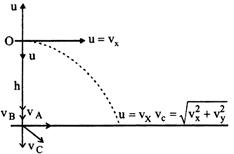 |
| Using \[{{v}^{2}}={{u}^{2}}+2as\,\,\,\Rightarrow \,\,\,{{v}_{A}}=\sqrt{{{u}^{2}}+2gh}\] |
| For B, going down with velocity u |
| \[\Rightarrow {{\text{v}}_{\text{B}}}=\sqrt{{{\text{u}}^{2}}+2\text{gh}}\] |
| For C, horizontal velocity remains same, i.e. u. |
| Vertical velocity \[=\sqrt{0+2\text{gh}}=\sqrt{2\text{gh}}\] |
| The resultant \[{{\text{v}}_{\text{C}}}=\sqrt{{{\text{v}}_{\text{x}}}^{2}+{{\text{v}}_{\text{y}}}^{2}}\text{=}\sqrt{{{\text{u}}^{\text{2}}}\text{+2gh}}.\] |
| Hence \[{{\text{v}}_{\text{A}}}={{\text{v}}_{\text{B}}}={{\text{v}}_{\text{C}}}\] |






You need to login to perform this action.
You will be redirected in
3 sec