
| (i) Plastic bags |
| (ii) Newspapers and journals |
| (iii) Screw and nuts |
| (iv) Vegetable peels |
| (v) Metal chips |
| (vi) Egg shells |
| RED | GREEN | BLUE |
| (i) and (iv) | (ii) and (iii) | (v) and (vi) |
| RED | GREEN | BLUE |
| (i) and (iii) | (ii) and (iv) | (iv) and (vi) |
| RED | GREEN | BLUE |
| (i), (iii) and (v) | (iv) and (vi) | (ii) only |
| RED | GREEN | BLUE |
| (i) and (v) | (ii) and (iv) | (iii) only |
| (i) excrete small amount of urine |
| (ii) excrete large amount of urine |
| (iii) excrete concentrated urine |
| (iv) excrete very dilute urine |
| Answer the following questions in one word or in a sentence only, |
| (i) Which of the things in the following list are non-living? |
| Plough, Mushroom, Sewing machine. Radio, Boat, Water hyacinth. Earthworm |
| Answer the following questions in one word or in a sentence only, |
| (ii) What are the conditions for the formation of shadow? |
| Answer the following questions in one word or in a sentence only |
| (iii) It was observed that a pencil sharpener gets attracted by both the poles of a magnet although its body is made up of plastic. Name a material that might have been used to make some part of it. |
| Answer the following questions in one word or in a sentence only |
| (iv) Which is the most abundant gas in our atmosphere? |
| Answer the following questions in one word or in a sentence only |
| (v) What do you understand by the segregation of garbage? |
| Answer the following questions in one word or in a sentence only |
| (vi) In a number of musical instruments, air plays an important role. Can you name some such instruments? |
| Read the poem written below and then answer the questions given below : |
| Blue and Green |
| Two bins, you mean? |
| Yes, they are there |
| to throw your waste. |
| But not in a hurry |
| Nor in a haste. |
| Select from waste, sieve if seems muddy |
| Separate all items and when they are ready |
| Place in a blue bin, or one that is green |
| For a voyage to the landfill, or for composting. |
| (i) Name the two kinds of waste that need to be separated from each other in two different waste bins. |
| (ii) Name two items of waste that need to be sent to a (a) landfill, (b) for composting. |
| Write just a few sentence for an imaginary situation if any of the following gases disappear from the atmosphere: |
| (a) oxygen |
| (b) nitrogen |
| (c) carbon dioxide |
| Which of the following statements are true and which ones are false? |
| (a) Water vapor is present in air only during the monsoon. |
| (b) Water evaporates into air from oceans, rivers and lakes but not from the soil. |
| (c) The process of water changing into its vapor is called evaporation. |
| Fig. A and B, show a bulb connected to a cell in two different ways. |
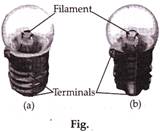 |
| (i) What will be the direction of the current through the bulb in both the cases. (Q to P or P to Q) |
| (ii) Will the bulb glow in both the cases? |
| (iii) Does the brightness of the glowing bulb depend on the direction of current through it? |
| (i) Rearrange the boxes given below to make a sentence that helps us to understand opaque objects: |
 |
| (ii) In a completely dark room, if you hold up a mirror in front of you, will you see a reflection of yourself in the mirror? |
| Read the features of plants given below : |
| (a) Thick waxy stem |
| (b) Short roots |
| (c) Cone shaped plants |
| (d) Sloping branches |
| (e) Small or spine-like leaves |
| (f) Hollow stem |
| Choose the type of plant for every feature given in a, b, c, d, e and f from the list given below: |
| Aquatic plant. Desert plant. Mountainous plant |
| Which of the non-living things listed below, were once part of a living thing? |
| Butter, Leather, Soil, Wool, Electric Bulb, Cooking oil. Salt, Apple, Rubber. |
| Provide one word answers to the statements given below: |
| (a) Help in the movement of body by contraction and relaxation. |
| (b) Bones that join with chest bone at one end and to the backbone at the other end. |
| (c) Framework of bones which gives shape to our body. |
| Observe Fig. and attempt the questions that follow it. |
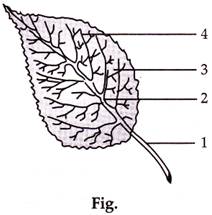 |
| (a) Label the parts 1, 2, 3 and 4 in the diagram. |
| (b) What type of venation does the leaf have? |
| (c) What type of venation is seen in grass leaves? |
You need to login to perform this action.
You will be redirected in
3 sec