
| The bisectors BI and CI of \[\angle B\]and \[\angle C\]of a \[\Delta ABC\]meet in I. What is \[\angle BIC\] equal to? |
A) \[90{}^\circ -\frac{A}{4}\]
B) \[90{}^\circ +\frac{A}{4}\]
C) \[90{}^\circ -\frac{A}{2}\]
D) \[90{}^\circ +\frac{A}{2}\]
Correct Answer: D
Solution :
| Given that, \[BI\]and \[CI\]are angle bisectors of\[\angle B\]and \[\angle C\]respectively. |
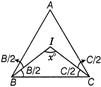 |
| Now, in \[\Delta BIC\] |
| \[x{}^\circ +\frac{B}{2}+\frac{C}{2}=180{}^\circ \] |
| [let \[\angle BIC=x{}^\circ \]] |
| \[\Rightarrow \]\[x{}^\circ =180{}^\circ -\frac{1}{2}(B+C)\] |
| \[\Rightarrow \]\[x{}^\circ =180{}^\circ -\frac{1}{2}(180{}^\circ -A)\] |
| \[[\because \text{in }\Delta ABC,A+B+C=180{}^\circ ]\] |
| \[\Rightarrow \]\[x{}^\circ =180{}^\circ -90{}^\circ +\frac{A}{2}\] |
| \[\therefore \]\[\angle BIC=x{}^\circ =90{}^\circ +\frac{A}{2}\] |






You need to login to perform this action.
You will be redirected in
3 sec