
| In a \[\Delta ABC,\]\[\angle A=80{}^\circ .\] If BD and CD are internal bisectors of \[\angle B\] and \[\angle C\] respectively, then \[\angle BDC\]is equal to |
A) \[100{}^\circ \]
B) \[110{}^\circ \]
C) \[120{}^\circ \]
D) \[130{}^\circ \]
Correct Answer: D
Solution :
| Given, \[\angle BAC=80{}^\circ \]and BD and CD are the bisector of \[\angle B\]and \[\angle C,\] |
| In \[\Delta ABC,\] |
| \[\angle BAC+\angle B+\angle C=180{}^\circ \] |
| [by angle sum property] |
| \[\Rightarrow \]\[80{}^\circ +\angle B+\angle C=180{}^\circ \] |
| \[\Rightarrow \] \[\angle B+\angle C=180{}^\circ -80{}^\circ \] |
| \[\angle B+\angle C=100{}^\circ \] |
| Divide by 2 on both the sides, we get |
| \[\frac{\angle B}{2}+\frac{\angle C}{2}=50{}^\circ \] |
| i.e. \[\angle DBC+\angle DCB=50{}^\circ \] |
| \[\left[ \because \frac{\angle B}{2}=\angle DBC\,\,\text{and}\,\,\frac{\angle C}{2}=\angle DCB \right]\] |
| Now, in \[\Delta BCO,\] |
| \[\angle BDC+\angle DBC+\angle DCB=180{}^\circ \] |
| [by angle sum property form Eq. (i)] |
| \[\Rightarrow \] \[\angle BDC+50{}^\circ =180{}^\circ \] |
| \[\Rightarrow \]\[\angle BDC=180{}^\circ -50{}^\circ =130{}^\circ \] |
| Alternate Method |
| In \[\Delta ABC,\] |
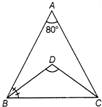 |
| and BD and CD are internal bisectors of \[\angle B\]and \[\angle C.\] |
| \[\therefore \] \[\angle BDC=90{}^\circ +\frac{1}{2}\angle A\] [by results] |
| \[=90{}^\circ +\frac{1}{2}\times 80{}^\circ =130{}^\circ \] |






You need to login to perform this action.
You will be redirected in
3 sec