
A) zero
B) \[10\sqrt{2}m/s\]
C) \[10\sqrt{3}m/s\]
D) \[10\,m/s\]
Correct Answer: D
Solution :
| [d] Let the particle be moving in counter clockwise direction. |
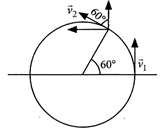 |
| The initial velocity of the particle \[{{\vec{v}}_{1}}=v\hat{j}\] |
| The velocity of the particle after time t is |
| \[v(\cos {{60}^{0}}\hat{j}-\sin {{60}^{o}}\hat{i})=\frac{v}{2}(j-\sqrt{3}\hat{i})\] |
| So, the change in velocity |
| \[|\Delta v|=|{{\vec{v}}_{2}}-{{\vec{v}}_{1}}|=v\left| \frac{1}{2}(\hat{j}-\sqrt{3}\hat{i})-\hat{j} \right|\] |
| \[=\frac{10}{2}\left| -\hat{j}-\sqrt{3}\hat{i} \right|=5\sqrt{{{(-1)}^{2}}+{{(-\sqrt{3})}^{2}}}=10m/s\] |






You need to login to perform this action.
You will be redirected in
3 sec