
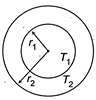
| The figure shows a system of two concentric spheres of radii\[{{r}_{1}},{{r}_{2}}\]and kept at temperatures \[{{T}_{1}},{{T}_{2}},\]respectively. The radial rate of flow of heat in a substance between the two concentric spheres, is proportional to [AIEEE 2005] |
 |
A) \[\frac{({{r}_{2}}-{{r}_{1}})}{({{r}_{1}}{{r}_{2}})}\]
B) in \[\left( \frac{{{r}_{2}}}{{{r}_{1}}} \right)\]
C) \[\frac{{{r}_{1}}{{r}_{2}}}{({{r}_{2}}-{{r}_{1}})}\]
D) \[({{r}_{2}}-{{r}_{1}})\]
Correct Answer: C
Solution :
| [c] To measure the radial rate of heat flow, we have to go for integration technique as here the area of the surface through which heat will flow is not constant. |
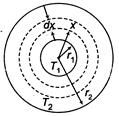 |
| Let us consider an element (spherical shell) of thickness ox and radius x as shown in figure. Let us first find the equivalent thermal resistance between inner and outer sphere. |
The thermal resistance of shell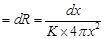 |
(from where K is thermal conductivity) where K is thermal conductivity) |
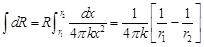
| The total thermal resistance, |
 |
 |
Now, rate of heat flow |
 |






You need to login to perform this action.
You will be redirected in
3 sec