
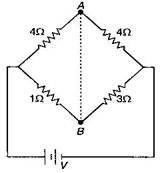
| In die circuit shown, if a conducting wire is connected between points A and B, the current in this wire will: [AIPMT (S) 2006] |
 |
A) flow from A to B
B) flow in the direction which will be decided by the value of V
C) be zero
D) flow from B to A
Correct Answer: D
Solution :
| [d] Key Idea: Current will flow from higher to lower potential. |
| Resistance \[4\,\Omega \] and \[4\,\Omega \] are connected in series, so their effective resistance is |
| \[R'=4+3=8\Omega \] |
| Similarly, \[1\,\,\Omega \] and \[3\,\,\Omega \] are in series |
| So, \[R''=1+3=4\,\Omega \] |
| Now \[R'\] and \[R''\] will be in parallel, hence effective resistance |
| \[R=\frac{R'\times R''}{R'+R''}\] |
| \[=\frac{8\times 4}{8+4}=\frac{32}{12}=\frac{8}{3}\,\Omega \] |
| Current through the circuit, from Ohms law |
| \[i=\frac{V}{R}=\frac{3V}{8}A\] |
| Let currents \[{{i}_{1}}\] and \[{{i}_{2}}\] flow in the branches as shown. |
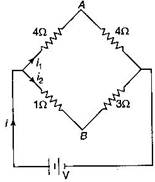 |
| \[\therefore \] \[8{{i}_{1}}=4{{i}_{2}}\] |
| \[\Rightarrow \] \[{{i}_{2}}=2{{i}_{1}}\] |
| Also \[i={{i}_{1}}+{{i}_{2}}\] |
| \[\Rightarrow \] \[\frac{3V}{8}={{i}_{1}}+2{{i}_{1}}\] |
| \[\Rightarrow \] \[{{i}_{1}}=\frac{V}{8}\,A\] |
| and \[{{i}_{2}}=\frac{V}{4}A\] |
| Potential drop at A, \[{{V}_{A}}=4\times {{i}_{1}}=\frac{4V}{8}=\frac{V}{2}\] |
| Potential drop at B, \[{{V}_{B}}=1\times {{i}_{2}}=1\times \frac{V}{4}=\frac{V}{4}\] |
| Since, drop of potential is greater in \[4\,\Omega \] resistance so. It will be at lower potential than B, hence, on connecting wire between points A and B, the current will flow from B to A. |






You need to login to perform this action.
You will be redirected in
3 sec