
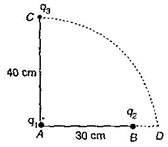
| Two charges \[{{q}_{1}}\] and \[{{q}_{2}}\] are placed 30 cm apart as shown in the figure. A third charge \[{{q}_{3}}\] is moved along the arc of a circle of radius 40 cm from C to D. The change in the potential energy of the system is \[\frac{{{q}_{3}}}{4\pi {{\varepsilon }_{0}}}\,k,\] where k is: [AIPMT (S) 2005] |
 |
A) \[8\,{{q}_{2}}\]
B) \[8\,{{q}_{1}}\]
C) \[6\,{{q}_{2}}\]
D) \[6\,{{q}_{1}}\]
Correct Answer: A
Solution :
| [a] Key Idea: The change in potential energy of the system is \[{{U}_{D}}-{{U}_{C}}\] as discussed under. |
| When charge \[{{q}_{3}}\] is at C, then its potential energy is |
| \[{{U}_{C}}=\frac{1}{4\pi {{\varepsilon }_{0}}}\left( \frac{{{q}_{1}}\,{{q}_{3}}}{0.4}+\frac{{{q}_{2}}\,{{q}_{3}}}{0.5} \right)\] |
| When charge q3 is at D, then |
| \[{{U}_{D}}=\frac{1}{4\pi {{\varepsilon }_{0}}}\left( \frac{{{q}_{1}}\,{{q}_{3}}}{0.4}+\frac{{{q}_{2}}\,{{q}_{3}}}{0.1} \right)\] |
| Hence, change in potential energy |
| \[\Delta U={{U}_{D}}-{{U}_{C}}\] |
| \[=\frac{1}{4\pi {{\varepsilon }_{0}}}\left( \frac{{{q}_{2}}\,{{q}_{3}}}{0.1}-\frac{{{q}_{2}}\,{{q}_{3}}}{0.5} \right)\] |
| but \[\Delta U=\frac{{{q}_{3}}}{4\pi {{\varepsilon }_{0}}}k\] |
| \[\therefore \] \[\frac{{{q}_{3}}}{4\pi {{\varepsilon }_{0}}}k=\frac{1}{4\pi {{\varepsilon }_{0}}}\,\left( \frac{{{q}_{2}}\,{{q}_{3}}}{0.1}-\frac{{{q}_{2}}\,{{q}_{3}}}{0.5} \right)\] |
| \[\Rightarrow \] \[k={{q}_{2}}\,(10-2)=8{{q}_{2}}\] |



You need to login to perform this action.
You will be redirected in
3 sec