Force, work and energy
Tit bits

Friction produces heat which is not always a disadvantage. For e.g., we use the heat produced by friction to light a match stick
- A force is a push or a pull. It can help us do work.
- A simple machine is a tool that helps us to do work easily. It does work when we apply a force.
- There are different classes of simple machines:
(a) Lever. (b) Pulley.
(c) Wheel and axle. (d) Inclined plane.
(e) Screw. (e) Wedge,
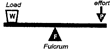
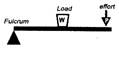
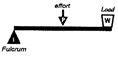
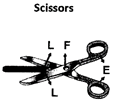
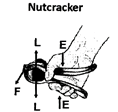
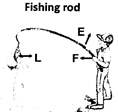
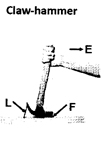
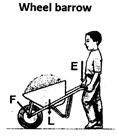
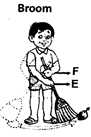
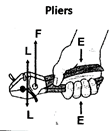
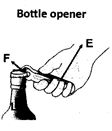
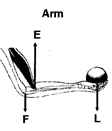
A lever is a simple machine. It is a rigid rod that turns about a fixed point called fulcrum. It consists of fulcrum (F), load (W) and effort (P)
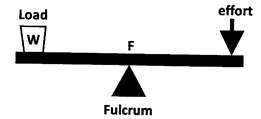
Levers are classified into three kinds according to the position of fulcrum, load and effort.
The three types of levers are shown in the table below:
|
Class of lever
|
1st class fulcrum between load and effort
l-F-E

|
2nd class
Load between
Fulcrum and effort
F-L-E

|
3rd class
Effprt netweem load and fulcrum
L-E-F

|
- The pulley is a wheel with a groove around its rim. The wheel turns around an axle. A belt or string fits into the groove.
- Examples of wheel and axle are pencil sharpeners, cross-spanners and water taps.
- The screw is an inclined plane wound around a cylinder.
- Other examples of inclined plane are staircases and winding roads. The wedge uses an inclined plane.
- A wedge consists of two inclined planes that meet at a sharp edge.
- The density of a substance is the weight of unit volume of the substance.
- When an object is immersed in water, it experiences an up thrust.
- According to Archimedes' principle, when an object is immersed in water, the up thrust is equal to the weight of water displaced by it.
- If the weight of an object is more than the up thrust, the object sinks in water. If the weight of the object is less than the up thrust, it floats on water.
- When an object is immersed in water, it loses weight equal to the weight of water displaced by it.