
 Let us look at some examples to understand the subject.
The main word is always noun and the adjective is the qualifier in the subject.
Identifying main word and qualifier
(a) The black goat was in the dark room.
Qualifier Main word
(b) My elder brother is a clerk.
Qualifier Main word
Qualifier is always placed before the main word.
To identify the predicate let us look at some examples:
(a) Tom named his house as pleasure house.
(b) The teacher appointed Max as monitor.
The complement is always noun or noun phrase.
Types of sentences
There are mainly five types of sentences.
1. Assertive or Declarative Sentences- The sentences which say something in a general way are called assertive or
declarative sentences.
2. Interrogative Sentences- The sentences which ask questions are called interrogative sentences.
3. Imperative Sentences- The sentences which express commands, requests or advices are called imperative sentences.
4. Exclamatory Sentences- The sentences which express sudden or strong feelings are called exclamatory sentences.
5. Optative Sentences- The sentences which express wishes, desires or prayers are called optative sentences.
Let us look at some examples to understand the subject.
The main word is always noun and the adjective is the qualifier in the subject.
Identifying main word and qualifier
(a) The black goat was in the dark room.
Qualifier Main word
(b) My elder brother is a clerk.
Qualifier Main word
Qualifier is always placed before the main word.
To identify the predicate let us look at some examples:
(a) Tom named his house as pleasure house.
(b) The teacher appointed Max as monitor.
The complement is always noun or noun phrase.
Types of sentences
There are mainly five types of sentences.
1. Assertive or Declarative Sentences- The sentences which say something in a general way are called assertive or
declarative sentences.
2. Interrogative Sentences- The sentences which ask questions are called interrogative sentences.
3. Imperative Sentences- The sentences which express commands, requests or advices are called imperative sentences.
4. Exclamatory Sentences- The sentences which express sudden or strong feelings are called exclamatory sentences.
5. Optative Sentences- The sentences which express wishes, desires or prayers are called optative sentences.
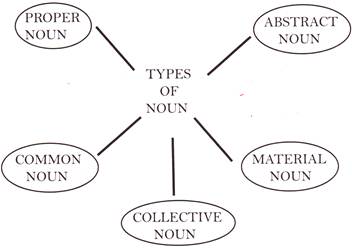 1. Proper Noun
A proper noun is the name of some particular person, place or thing.
For example:
Ashoka was a wise king. Here, Ashoka is the proper noun.
2. Common Noun
A common noun is a name given in common to every person or thing of the same class or kind.
For example:
The boy plays in the playground. Here, boy is the common noun.
3. Collective Noun
A collective noun is name of a number of person or things taken together.
For example:
There was a great crowd. Here, crowd is the collective noun.
4. Material Noun
A material noun is the word used for the substance of which things are made.
For example: Brass is yellow. Here, brass is the material noun.
5. Abstract Noun
An abstract noun is usually the name of a quality, action, or state considered apart from the object to which it belongs.
For example:
I remember my childhood. Here, childhood is an abstract noun.
2. PRONOUN
A pronoun is a word which is used in place of a noun.
Kinds of Pronoun:
1. Personal Pronoun
Personal pronoun stands for person or thing.
For example:
I am young. Here, I is a personal pronoun.
2. more...
1. Proper Noun
A proper noun is the name of some particular person, place or thing.
For example:
Ashoka was a wise king. Here, Ashoka is the proper noun.
2. Common Noun
A common noun is a name given in common to every person or thing of the same class or kind.
For example:
The boy plays in the playground. Here, boy is the common noun.
3. Collective Noun
A collective noun is name of a number of person or things taken together.
For example:
There was a great crowd. Here, crowd is the collective noun.
4. Material Noun
A material noun is the word used for the substance of which things are made.
For example: Brass is yellow. Here, brass is the material noun.
5. Abstract Noun
An abstract noun is usually the name of a quality, action, or state considered apart from the object to which it belongs.
For example:
I remember my childhood. Here, childhood is an abstract noun.
2. PRONOUN
A pronoun is a word which is used in place of a noun.
Kinds of Pronoun:
1. Personal Pronoun
Personal pronoun stands for person or thing.
For example:
I am young. Here, I is a personal pronoun.
2. more... | Length | Metre (m) |
| Mass | Kilogram (kg) |
| Capacity | Litre |
| \[\mathbf{1cm =}\frac{\mathbf{1}}{\mathbf{100}}\mathbf{m = 0}\mathbf{.01m}\] \[\mathbf{1m =100 cm}\] |
| \[\mathbf{1 cm = 10 mm}\] \[\therefore \] \[\mathbf{1mm=}\frac{\mathbf{1}}{\mathbf{10}}\mathbf{cm=0}\mathbf{.1cm}\] |
| \[\mathbf{10 mm = 1cm, 10 cm = 1dm, 10 dm = 1m,}\]\[\mathbf{10m = 1Dm, 10Dm = 1 Hm, 10 Hm = 1Km}\] \[\mathbf{1000 cm = 1m}\] \[\mathbf{1000 m = 1km}\] |
| \[\mathbf{1000 m = 1 km}\] \[\therefore \]\[\mathbf{1m = }\frac{\mathbf{1}}{\mathbf{1000}}\mathbf{ km = 0}\mathbf{.001 km}\] |
| \[\mathbf{1000 mg = 1g}\] \[\mathbf{1000 g = 1 kg}\] \[\therefore \] \[\mathbf{1g =}\frac{\mathbf{1}}{\mathbf{1000}}\mathbf{ kg = 0}\mathbf{.001 kg}\] |
 \[\therefore \]\[\text{1 m}l\text{ = }\frac{\text{1}}{\text{1000}}\text{ }l\text{ = 0}\text{.001}l\]
|

You need to login to perform this action.
You will be redirected in
3 sec