Current Affairs Teaching

  Nationalist Movement and Social Reforms   LEARNING OBJECTIVES
  • Understand the oriental tradition towards the society and the education and its criticism
  • Know the reasons for emergence of reform movements
  • Explore the various movements such as Brahmo Samaj, Arya Samaj, and Prarthana Samaj
  • Identify the reform movements among the Muslims, Sikhs, and Parsis
  • Recognise the various phases of national movement in India
  INTRODUCTION The chapter deals with a colonial period when India was subjugated to British control, and now, British power has started interfering in Indian society that culminated into restructuring of the society. The reasons of British involvement in the society and changes introduced by them will be explored and the reaction of natives to these changes will also be noted. Further, the rise of national consciousness among Indian masses resulting in nationalist movement will be traced. The conquest of India by the British during 18th and 19th centuries had exposed some serious weaknesses and drawbacks of Indian social institutions. As a consequence, several individuals and movements sought to bring about changes in the social and religious practices with a view of reforming and revitalising the society. These efforts were collectively known as Renaissance, which means revival and re-birth. Further, these developments in the Indian society were labelled as Indian renaissance.   'The sun never sets on the British Empire'. It is a strong phrase that comments on illustrious history of Great Britain as a coloniser of many parts of the world in the age of imperialism. The process of colonisation that begins with political conquest of colony involves economic control in the next phase and further impacts every aspect of peoples' lives in the colony such as their culture, work, and education because bruisers believed it as 'White man's Burden' to civilise the inferior, ignorant native of colony. India being a colony of Great Britain witnessed it all. Here, we will explore the implications of British colonisation on the Indian education and society.   ORIENTAL TRADITION The early image of India in the West was that of past glory crafted by the Aryans, who are  the distant kin of the Europeans, accompanied by an idea of degeneration of once magnificent Aryan civilisation, and thus, there was an urge to know Indian culture and tradition, which was reflected in endeavours of scholars like Sir William Jones who was a linguist and junior judge at the supreme court set up by a company in Calcutta. He studied Indian languages to restore the forgotten culture and legal system by translating ancient Indian texts. His interests were shared by many other English officials in Calcutta, such as Henry Thomas Colebrooke and Nathaniel Halhed, who had translated Sanskrit and Persian texts into English. These Englishmen had together set up the Asiatick Society of Bengal (1784) and started a journal called Asiatick Researches. This was the beginning of orientalist tradition that led to the founding of institutions such as Calcutta Madrassa (1781) by Warren Hastings and Hindu more...

  India after Independence   LEARNING OBJECTIVES
  • Understand the challenges faced by India after independence
  • Know the drafting of the constitution of India
  • Explore the process of state formation in India
  • Be aware of the formation of Indian Foreign Policy
  • Realise where India is after 70 years of Independence
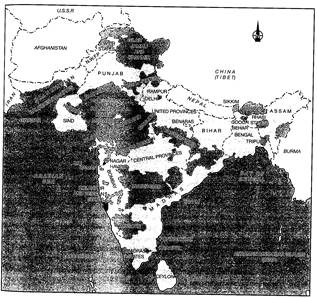
  INTRODUCTION On 15 August 1947, India became independent after a long freedom struggle with the British. India got independence at the midnight of 15 August 1947. This independence was itself a chain of long struggle and incidences. These incidents not only changed the geographical boundaries of Indian subcontinent but also changed the life of the people who lived in here for hundreds of years. We all know that India is one of the oldest civilisation in the world; however, the new form of state is different from the governance of Mughal empire and other kingdoms and regional states' governance system.   OLDEST CIVILISATION IN THE FORM OF A NEW AND DIVIDED NATION We all know that British empire itself was a complex structure of governance. Some states were directly governed by Britishers and others were governed by alliances with local princely states. Let us see a picture of British India and try to understand their ruling system: Two colours yellow and pink are used in this map. Yellow areas are directly ruled by Britishers and pink areas are ruled by regional kingdoms or princely states under British treaties. At the time of independence, around 565 princely states were ruled under Britishers. Further, during that time, the British government gave the right to the princely states to choose what they want. This means whether they want to be merged themselves either as India or Pakistan or they want to become an independent princely state. We first understand how Hindustan got divided into two nations: India and Pakistan. It is a long story, and therefore, we discuss it here briefly. In 1942, a biggest change happened in the Figure 9.1 India provinces and princely states before 15 August 1947   Indian history and that was Muslim League; they presented two-nation theory and these two nations are Hindus and Muslims. They presented these two religions as two nations, and clearly, they stated that it was not possible for them to live together in the newly independent country because Muslims are in minority and Hindus are in majority. They could not see more opportunities to progress their community. Their customs are different, and therefore, it was not possible to live together. Many things were done in this period. We cannot blame someone because many factors were caused due to this situation. The fundamentalists of both Hindus and Muslims played a role in dividing Hindustan in India and Pakistan. It is really painful situation for millions of people who migrated from India to Pakistan and Pakistan to India. The severally affected area by partition is Punjab, Rajasthan, more...
  Solar System   LEARNING OBJECTIVES
  • Become familiar with solar system
  • Become aware about the various planets in our social system along with their characteristics
  • Develop understanding about our planet 'The Earth'
  • Explore about the position and characteristics of moon
  INTRODUCTION Sun is the base of our solar system, and the planets of the solar system revolve around it continuously in different speeds. All the planets have their respective moons except Mercury and Venus. Solar system consists of not only planets but also millions of asteroids, rocks, and so on. The gravity of Sun is the foremost power in our solar system. The formation of planets and other things available in our solar system are constructed during the formation of Sun. Initially, there were gases and dust particles that formed the Sun, and later, it spread all over. Then, gradually, it became the cause of the formation of various planets. The age of our solar system is approximately four to six billion years. Scientists believe that our solar system is formed with gas, dust and such other particles (solar nebula). Because of the collapsing of nebula due to gravity, it started spinning faster and compressed into a disc. Whatsoever was spread around was pulled inside and Sun was formed. Rest of the particles collided together and formed planets, moons, and so on. The wind of Sun pushed the lighter objects away and the heavier ones remained in innermost level, and those were small and hard. It is important to understand that there are no boundaries in space. In our solar system, the entire planets orbit around the Sun. Neptune is the outermost planet that orbits and revolves around 30 astronomical units from the sun. Astronomical unit is calculated as follows: One astronomical unit = Distance between Sun and Earth (149 million km) As discussed earlier, we have one star, that is, the sun and eight planets in our solar system. However, interestingly, we can see Mercury, Venus, Mars, Jupiter, and Saturn with naked eyes or without any additional instruments like telescopes, but for Uranus and Neptune, we need telescopes to see them. All planets of our solar system can be categorised into two types, namely rocky (terrestrial) and gaseous planets. Rocky planets include Mercury, Earth, Venus, and Mars. These all have similar composition such as Earth, whereas gaseous planets include Jupiter, Uranus, Saturn, and Neptune, in which Jupiter and Saturn carries highest amount of hydrogen and helium. There are four planets that have rings around them and these are Jupiter, Uranus, Saturn, and Neptune.   PLANETS The galaxy that we live in is named as 'Milky Way', and it has many planets of different nature, shape, and size. Currently, there are eight planets in our solar system including Earth. As of now, Earth is the only planet that supports life from microorganisms to human beings. In this chapter, we will explore about these planets.   Mercury It is the nearest planet to the more...

  Earth in Solar System   LEARNING OBJECTIVES
  • Understand the origination and formation of Earth
  • Be aware of the composition of Earth
  • Explore the internal formation of earth, which is categorised into three different layers: the
  • crust, the mantle, and the core
  • Understand the rocks and their various forms
  • Familiarise the volcanoes and earthquakes
  INTRODUCTION The earth is the only planet with conducive environment to sustain life. It is continuously changing inside and outside. The earth is not same as it was millions of years ago or let us say thousands of years ago. We know that Indian plateau is sliding towards the north, Himalaya's height is increasing every year, earthquakes and volcanoes are changing the shape of landforms of the earth and all these processes are perpetuating from the time the earth came into existence. What are the reasons of such incidents and activities? To understand this, we have to understand the formation of earth from inside and outside. For this, let us understand the composition of earth.   Some important facts about Earth Age                                                                   ?         4.6 billion years Mass                                                                 ?         5.972 x 10 (power 24) I Volume                                                 ?         1.083 x 10 (power 24) I Average density                                      ?         5,514 kg/I Shape                                                               ?         Oblate Spheroid Surface area                                                       ?         51,00,66,000 sq. km Equatorial diameter                                             ?         12,756 km Polar diameter                                                    ?         12,713.6 km                                                        Average surface temperature                                 ?         14.c. Highest is 58.c (Libya) and lowest is 89.c (Antarctica) Highest land point                                               ?         mt. Everest (Nepal) 8,850 m Deepest ocean point                                            ?         Mariana trench (Pacific Ocean) 11,033 m Speed of rotation around sun                                ?         29.8 km/s                                           Distance from sun                                               ?         15-2 million km (at aphelion) and 147 million km (at perihelion)   Earth was also formed almost at the same time when sun became a star; that is, 4.6 billion years ago. The sun is formed when nebula collapsed due to gravity. It started to spin faster and condensed into dust. Largely, all materials were gone into the centre and the sun was formed. The remaining particles that were available in the dust collided together to form various bodies and earth is one of them (refer Chapter 1, Solar System). If we trace the history of the earth, we will know that it had been divided into four eras: Hadean, Archean, Proterozoic, and Phanerozoic. The first three are called Precambrian. Archaean is the time when the first life on the earth came into existence. The Phanerozoic can also be understood in three eras: Palaeozoic, Mesozoic, and Cenozoic. It is important to understand that the earth is surrounded by air that gets thicker as we go away from the surface (approximately 160 km). However, the atmosphere is found at 600 km above from the earth. Troposphere is the lowest layer of atmosphere and is always in motion. Sunlight heats the body of the earth that causes rain (systematic process). The atmosphere is about 48 more...
Learning, Motivation and Emotion   How do children learn?   Plato: "Children are born with knowledge that simply awaits activation".                   John Locke: was of the view that the main objective of education is self-control. Children will learn properly and with interest only when the find the instruction enjoyable. Adults should use positive reinforcement such as praise rather than punishment to enable a child to learn.   Jean Jacques Rousseau: Development occurs according in a series of stages. Children should not be compelled to learn things they may not be ready for. They will learn when they are curious and it is our responsibility as adults to let the learning unfold naturally. He wrote books about a hypothetical child, Emile, where he allowed nature to raise the child so that the child is unencumbered by the pressures of the civilized society. The only way to interfere is to present lessons that were suited to the child's age and with minimal guidance and never correct Emile's mistakes.   Friedrich Froebel: saw young children as individuals who need a certain degree of freedom but also need to participate in and give society something good in return. He opened experimental preschools in Germany that he called "kindergartens" illustrating his idea that the child will grow well if properly nurtured and cared for. Froebel is best known for his emphasis on guided play as a method for learning.   John Dewey: Dewey's ideas are much like Froebel's in terms of child-centered education based on children's interests and that they learn best through play and real life experiences. School life should grow out of home life and experience. Teachers should know their children well and accordingly plan and document a purposeful curriculum. The major tenet for Dewey was problem solving that is learning through doing'.   Erik Erikson: His theory comprised of eight stages where each stage (birth to old age) has a particular issue to be resolved or accomplished before moving satisfactorily to the next stage. The stages are:  
  • Trust versus mistrust
  • Autonomy versus Shame and doubt
  • Initiative versus Guilt
  • Industry versus Inferiority
  • Identity versus Identity confusion
  • Intimacy versus Isolation
  • Generativity versus Stagnation
  • Ego integration versus Despair
  Jean Piaget: Swiss psychologist Jean Piaget showed that intelligence is the result of a natural sequence of stages and it develops as a result of the changing interaction of a child and its environment. He devised a model describing how humans go about making sense of their ' by gathering and organizing information.   Stages of development all children go through:  
  • Sensori-motor
  • Preoperational
  • Concrete operations
  • Formal operations
  Cognitive development is much more than the addition of new facts and ideas to an existing store of information. According to Piaget, our thinking processes change radically, though slowly from birth to maturity because we constantly strive to make sense of the world. Piaget identifies four factors namely biological maturation, activity, social experiences, and equilibration that interact to more...

Assessment and Evaluations   Assessment is a process of obtaining information about students' learning and making value judgments about their progress. Information about students' progress can be obtained from a variety of sources including projects, assignments, performances/ observations, and tests. Students' learning is often assigned specific numbers or grades and this involves measurement.   Measurement takes into account such questions as, "How much?" and is used most commonly when the teacher scores a test or product and assigns numbers (e.g. 28 /30 on English test; 90/100 on the environmental science project).   Evaluation is the process of making judgments about the assessment information. These judgments may be about individual students (e.g. should Rahul's course grade take into account his significant improvement over the grading period?), the assessment method used (e.g. is the essay type test a useful way to obtain information about problem solving), or one's own teaching (e.g. most of the students this year did much better on the essay assignment than last year so my new teaching methods seem effective).   Assessment for learning is often formative assessment, i.e. it takes place during the course of instruction by providing information that teachers can use to revise their teaching and students can use to improve their learning. Formative assessment includes both informal assessment involving spontaneous unsystematic observations of students' behaviours (e.g. during a question and answer session or while the students are working on an assignment) and formal assessment involving pre- planned, systematic gathering of data.   Assessment of learning is summative assessment that involves assessing students in order to certify their competence and fulfill accountability mandates and is the primary focus of the next chapter on standardized tests but is also considered in this chapter. Assessment of learning is typically summative, that is, administered after the instruction is completed (e.g. a final examination in an educational psychology course). Summative assessments provide information about how well students mastered the material, whether students are ready for the next unit, and what grades should be given.   For an assessment to be high quality it needs to have good validity and reliability as well as absence from bias.   Validity   Validity of assessment means that the assessment measures what it is supposed to measure. For example, how appropriate is it to conclude that the results of a language test on grammar given to recent immigrants accurately represents their understanding of grammar? Is it alright for the teacher to conclude, based on the observation of her student, Ruhi that she has Attention Deficit Disorder because she does not follow the teachers verbal instructions? Obviously in each situation other interpretations are possible that the immigrant students have poor English skills rather than mathematics skills, or that Ruhi may be hearing impaired.   Reliability   Reliability refers to the consistency of the measurement. Suppose Mr. Kapur is teaching a unit on food chemistry in his tenth grade class and gives an assessment at the end of the unit using more...

Learning through Problem Solving and Constructivism, Memory and Forgetting   PROBLEM SOLVING   Problem solving means arriving at solution of tasks or situations that are complex or ambiguous with difficulties or obstacles of some kind. Problem solving is needed, for example, when a doctor analyzes a lung X-ray: a picture of lungs requires skill, experience, and resourcefulness to decide which obscure-looking blobs to ignore, and which to interpret as real structures. Problem solving is also needed when a store manager has to decide how to improve the sales of his product: should she price it lower or publicize it more through advertisements.   Most often, when two children take their problem to an adult to solve for them and the adult "steps in" without invitation, the adult has assumed ownership of the problem. When the adult makes an independent judgment, it usually results in a win-lose situation. One child gets what he wants, the other doesn't. However, by guiding children through a series of problem solving steps, the adult can teach students how to solve their own problems and make better decisions so it's a win-win situation.   Teachers help their students solve problems and make better decisions through a six step process.   Step 1: Define the problem or situation. Good solutions are dependent on precise identification of the problem at hand. Questions that should be asked at the start include "What is going on here?" "What problems do we have?' "What exactly do we need to do to solve?" and "is there another grave problem here?"   Step 2: Generate alternatives. Once the problem is identified and clarified, a host of feasible solutions should be generated. To think of ideas, questions such as the following are normally helpful: "What can be done differently?" What rules or procedures should be followed?" "Let's see how many ideas we can generate" and "Are there more solutions we can think of?"   Step 3: Evaluate the alternatives: Participants comment on the alternatives generated the goal is to choose a solution which has a consensus. It is appropriate to take an opinion of others on each alternative. "What do you think of this alternative or solution?" "What are its pros and cons?" "What problems does it leave unsolved?" and "if we try this idea, what can be the outcome?"   Step 4: Make the decision. After examining the alternatives, the one that seems to fit the best is selected for trial.   Step 5: Implement the solution or decision. The trial solution is put into execution with the understanding that it may or may not work as expected and that it can be altered if necessary.   Step 6: Conduct a follow-up evaluation. The results of the trial solution are analyzed arid evaluated. Some useful questions include "Was this a good decision?" "Did it actually solve the problem?" "Is everyone happy with the decision" and "How effective was our decision?" If the solution or decision is more...

Inclusive Education   Inclusive education is an approach to educating students with special educational needs. Under the inclusion model, students with special needs spend most or all of their time with non-disabled students though the implementation of these practices varies from school to school. Schools most frequently use them for selected students with mild to severe special needs.   Inclusive education differs from notions held earlier of 'integration' and 'mainstreaming', which tended to be concerned principally with disability and 'special educational needs' and implied learners changing or becoming 'ready for' or deserving of accommodation by the mainstream. By contrast, inclusion is about the child's right to participate and the school's duty accept the child. Inclusion rejects the use of special schools or classrooms to separate students with disabilities from students without disabilities. It seeks to address the learning needs of all children, youth and adults with a specific focus on those who are vulnerable to marginalization and exclusion. It emphasizes full participation by students with disabilities and respect for their social, civil, and educational rights.   NATIONAL CURRICULUM FRAMEWORK- 2005   The Social Context of Education   Caste hierarchies, socio-economic status, gender bias, cultural diversity etc. characterize Indian society and deeply influence access to education and participation of children in school. This is evident in the sharp differences between different social and economic groups, which are reflected in school enrolment and completion rates. Thus, girls from SC and ST communities in both rural and urban areas and the disadvantaged sections of religious and other ethnic minorities are educationally most vulnerable. In urban areas and a lot of villages, the school system itself is stratified and provides children with appallingly different educational experiences. Differences in render relations not only perpetuate domination but also create anxieties and stifle the freedom of both boys and girls to develop their capacities to their fullest.   The impact of globalization in every sphere of society has important implications for education. On the one hand, we are witnessing the increasing commercialization of education, and, on the other hand, inadequate public funding for education and the thrust towards 'alternative' schools. These factors indicate a shifting of responsibility for education from the state to the family and the community. We need to be alert about the commodification of schools and the application of market-related concepts to schools and school quality. The increasingly competitive environment into which schools are being drawn and the aspirations of parents place a tremendous burden of stress and anxiety on all children, including the very young, to the detriment of their personal growth and development, and thus hampering the inculcation of the joy of learning.   RTE-SSA REPORT (Right to Education - Sarva Shiksha Abhiyan Report)   The RTE Act has important implications for the overall approach and implementation strategies of Sarva Shiksha Abhiyan and it is necessary to harmonize the SSA vision, strategies and norms with the RTE mandate. The RTE has defined children belonging to disadvantaged group and more...

Progressive Education   Progressive education is a movement pertaining to pedagogy that began in the late nineteenth century and has persisted in various forms till date. The term "progressive" was engaged to distinguish this education from the traditional curriculum of the 19th century, which was rooted in classical preparation for the university and strongly differentiated by socio-economic level. By contrast, progressive education finds its roots in present experience. Most progressive education programs have these qualities in common:  
  • Learning by doing - hands-on projects and experiential learning
  • Integrated curriculum
  • Problem-solving and critical thinking
  • Collaborative Group work and development of social skills
  • Understanding and action as opposed to rote learning
  • Projects on social responsibility and democracy
  • Integration of community service and service learning projects into the daily curriculum
  • De-emphasis on textbooks
  • Life-long learning and social skills
  • Assessment by evaluation of child's projects and productions
  PROGRESSIVE EDUCATION   John Dewey remembered as the "father of Progressive education/' was the most eloquent and influential figure in educational Progressivism.   Dewey's vision for the school was inextricably tied to his larger vision of the good society wherein each classroom represented a microcosm of the human relationships that constituted the larger community. Dewey believed that the school, as a "little democracy," could create a "more lovely society." Dewey's emphasis on the importance of democratic relationships in the classroom setting necessarily shifted the focus of educational theory from the institution of the school to the needs of the students. This dramatic change in American pedagogy, however, was not alone the work of John Dewey.   Second, Dewey and his fellow educational Progressives drew from the work of the German philosopher Friedrich Froebel and Swiss educator Johann Pestalozzi. Froebel and Pestalozzi were among the first to coherently opine that the process of education should be concerned with educating the "whole child," wherein learning shifted from the subject matter and eventually rested upon the needs and interests of the child. Taking care of both the pupil's head and heart, they believed, was the real work of schooling. Froebel drew upon the garden metaphor of cultivating young children toward maturity, and he provided the European foundations for the late-nineteenth-century kindergarten movement in the United States. Similarly, Pestalozzi popularized the pedagogical method of object teaching, wherein a teacher began with an object related to the child's world in order to initiate the child into the world of education.   Finally, Dewey drew inspiration from the ideas of philosopher and psychologist William James. Dewey's interpretation of James's philosophical pragmatism, which was similar to the ideas underpinning Pestalozzi's object teaching, joined thinking and doing as two seamlessly connected halves of the learning process. By focusing on the relationship between thinking and doing, Dewey believed his educational philosophy could equip each child with the more...

Individual Differences and Intelligence; Thought and Language   As the term implies, individual differences are qualities that are unique; just one person has them at a time. Variation in hair color, for example, is an individual difference; even though some people have nearly the same hair color, no two people are exactly the same.   Group differences are qualities shared by members of an identifiable group or community, but not shared by everyone in society. An example is gender role: for better or for worse, one portion of society (the males) is perceived differently and expected to behave a bit differently than another portion of society (the females).   Individuals with similar, but nonetheless, unique qualities sometimes group themselves together for certain purposes, and groups unusually contain a lot of individual diversity within them. If you happen to enjoy playing soccer and have some talent for it (an individual quality), for example, you may end up as a member of a soccer team or a club (a group defined by members' common desire and ability to play soccer).But though everyone on the team fits a "soccer player's profile" at some level, individual members will probably vary in level of skill and motivation. The group, by its very nature, may obscure these signs of individuality.   Individual Styles of Learning and Thinking   All of us, including our students, have preferred ways of learning. Teachers often refer to these differences as learning styles, though this term may imply that students are more consistent across situations than is really the case. One student may like to make diagrams to help remember a reading assignment, whereas another student may prefer to write a sketchy outline instead. Yet in many cases, the students could in principle reverse the strategies and still learn the material: if coaxed (or perhaps required), the diagram-maker could take notes for a change and the note- taker could draw diagrams. Both would still learn, though neither might feel as comfortable as when using the strategies that they prefer. This reality suggests that a balanced, middle-of-the- road approach may be a teacher's best response to students' learning styles. Or put another way, it is good to support students' preferred learning strategies where possible and appropriate, but neither necessary nor desirable to do so all of the time.   Some students may prefer to hear new material rather than see it; they may prefer for you to explain something orally, for example, rather than to see it demonstrated in a video. Some prefer to be the other way round. There is evidence that individuals, including students, do differ in how they habitually think. These differences are more specific than learning styles or preferences, and psychologists sometimes call them cognitive styles, meaning typical ways of perceiving and remembering more...


You need to login to perform this action.
You will be redirected in 3 sec spinner