
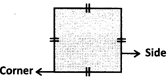
 It has four sides and four corners.
All its sides are of the same length.
(ii) Rectangle
It has four sides and four corners.
All its sides are of the same length.
(ii) Rectangle
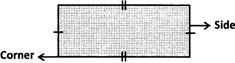 It has four sides and four corners.
The opposite sides of a rectangle are of the same length.
(iii) Triangle
It has four sides and four corners.
The opposite sides of a rectangle are of the same length.
(iii) Triangle
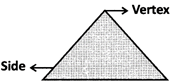 It has three sides and three vertices.
(iv) Cuboid
It has three sides and three vertices.
(iv) Cuboid
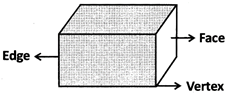 It has 6 flat faces, 12 straight edges and 8 vertices.
(v) Cube
It has 6 flat faces, 12 straight edges and 8 vertices.
(v) Cube
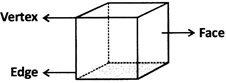 (vi) Cylinder
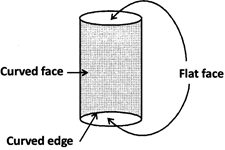 It has 3 faces
\[\to\]
1 curved face and 2 flat faces.
It has 2 curved edges.
(vii) Cone
It has 3 faces
\[\to\]
1 curved face and 2 flat faces.
It has 2 curved edges.
(vii) Cone
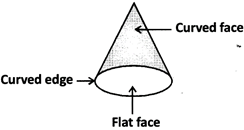 It has 2 faces
\[\to\]
1 curved face and
It has 1 curved edge.
It has 2 faces
\[\to\]
1 curved face and
It has 1 curved edge.
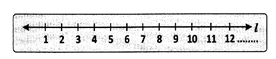
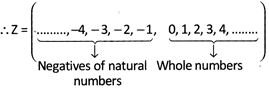 1, 2, 3, 4, .... etc., are called positive integers and are denoted by\[{{Z}^{+}}\].
\[\therefore \]\[{{Z}^{+}}\]= {1, 2, 3, 4, .......}
-1, - 2, -3, - 4, ...... etc., are called negative integers and are denoted by\[{{Z}^{-}}\].
\[\therefore \]\[{{Z}^{-}}\]= {..............-3,-2,-1}
Note: 1.Usually negative numbers are placed in brackets to avoid confusion arising due to two signs I evaluations. e.g., 3+ (-5) =-2
1, 2, 3, 4, .... etc., are called positive integers and are denoted by\[{{Z}^{+}}\].
\[\therefore \]\[{{Z}^{+}}\]= {1, 2, 3, 4, .......}
-1, - 2, -3, - 4, ...... etc., are called negative integers and are denoted by\[{{Z}^{-}}\].
\[\therefore \]\[{{Z}^{-}}\]= {..............-3,-2,-1}
Note: 1.Usually negative numbers are placed in brackets to avoid confusion arising due to two signs I evaluations. e.g., 3+ (-5) =-2
 On a number line when we
(a) Add a positive integer, we move to the right.
(b) Add a negative integer, we move to the left.
(c) Subtract a positive integer, we move to the left.
(d) Subtract a negative integer, we move to the right.
On a number line when we
(a) Add a positive integer, we move to the right.
(b) Add a negative integer, we move to the left.
(c) Subtract a positive integer, we move to the left.
(d) Subtract a negative integer, we move to the right.
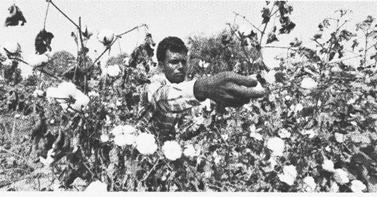 A Cotton farmer
Shivram is a cotton farmer in Salem, Tamil Nadu. He
grows cotton in his small field. When the harvest is ready and he collects
enough kapas1 in his godown; he loads them in a lorry or a bullock cart and
takes them to the wholesale market or mandi. Shivram sells his cotton to Ratan,
a wholesaler at the mandi in pothis2. He earns Rs. 0,000 for his entire produce
of cotton. Shivram will use this money to buy new seeds, farming equipment and
fulfil his daily needs over the next few months. Ratan, on the other hand, sells
the same cotton in quintals and earns much more than Shivram.
Q. Do you
think the money Shivram gets is sufficient to lead a good life?
A Cotton farmer
Shivram is a cotton farmer in Salem, Tamil Nadu. He
grows cotton in his small field. When the harvest is ready and he collects
enough kapas1 in his godown; he loads them in a lorry or a bullock cart and
takes them to the wholesale market or mandi. Shivram sells his cotton to Ratan,
a wholesaler at the mandi in pothis2. He earns Rs. 0,000 for his entire produce
of cotton. Shivram will use this money to buy new seeds, farming equipment and
fulfil his daily needs over the next few months. Ratan, on the other hand, sells
the same cotton in quintals and earns much more than Shivram.
Q. Do you
think the money Shivram gets is sufficient to lead a good life?
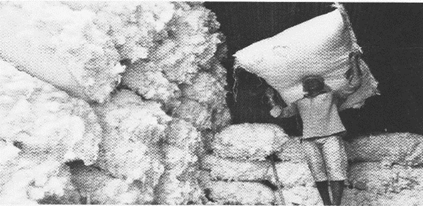 A wholesale market of cotton
Textile mill owners approach the wholesale dealer at
the mandi to buy cotton. Ratan sells Shivram's produce at Rs. 5,000 for each
quintal to Shambhu and earns a profit.
A wholesale market of cotton
Textile mill owners approach the wholesale dealer at
the mandi to buy cotton. Ratan sells Shivram's produce at Rs. 5,000 for each
quintal to Shambhu and earns a profit.
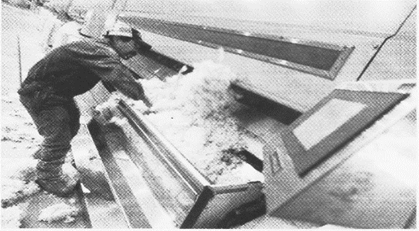 A wholesale market of cotton
Shambhu owns a cotton gin in Tirupur. He has employed
many spinners who spin cotton into yarn. After the cotton yarn is spun, Shambu
sells it at a high price to traders at the Tirupur cloth market.
Raghu is a trader at the Tirupur cloth market. Raghu
buys the yarn from Shambu and gives it to his weavers to weave cloth. He pays
each of his weavers a salary of 2,000 per month. Sita is a weaver employed by
Raghu. She works
10-12 hours more...
A wholesale market of cotton
Shambhu owns a cotton gin in Tirupur. He has employed
many spinners who spin cotton into yarn. After the cotton yarn is spun, Shambu
sells it at a high price to traders at the Tirupur cloth market.
Raghu is a trader at the Tirupur cloth market. Raghu
buys the yarn from Shambu and gives it to his weavers to weave cloth. He pays
each of his weavers a salary of 2,000 per month. Sita is a weaver employed by
Raghu. She works
10-12 hours more... 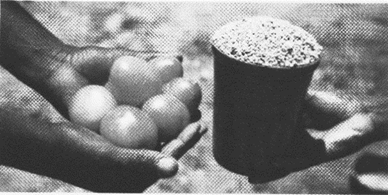 Barter system
Q. why do
you think barter system did not work for long?
RETAIL MARKETS
Retail markets include shops at fixed locations such
as weekly markets, local neighbourhood markets, supermarkets and malls. These
are all consumer markets.
WEEKLY MARKETS
Weekly markets are set up in almost every district on
different days of the week. They are called by different names such as Monday
market, Shani bazaar, etc. One can buy fresh vegetables and fruits, clothes,
stationery and many other things at very reasonable prices at these markets.
The vendors of this market have stands, carts or even sell their goods spread
on the ground. This is because they shift from one area to another. Farmers and
craftspersons get an opportunity to sell their goods directly to the consumer
at these markets. Such markets are also called haats.
Barter system
Q. why do
you think barter system did not work for long?
RETAIL MARKETS
Retail markets include shops at fixed locations such
as weekly markets, local neighbourhood markets, supermarkets and malls. These
are all consumer markets.
WEEKLY MARKETS
Weekly markets are set up in almost every district on
different days of the week. They are called by different names such as Monday
market, Shani bazaar, etc. One can buy fresh vegetables and fruits, clothes,
stationery and many other things at very reasonable prices at these markets.
The vendors of this market have stands, carts or even sell their goods spread
on the ground. This is because they shift from one area to another. Farmers and
craftspersons get an opportunity to sell their goods directly to the consumer
at these markets. Such markets are also called haats.
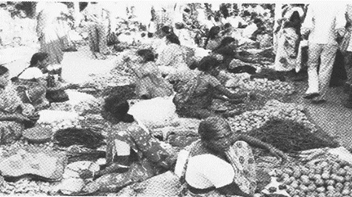 A Weekly market
Haats or street markets are popular because they are
affordable and colourful. They are set up everywhere and offer all goods
ranging from food to clothes. The rates of the items are lower as the vendors
make purchases from the wholesale markets or handicraft the goods themselves.
These markets are also more...
A Weekly market
Haats or street markets are popular because they are
affordable and colourful. They are set up everywhere and offer all goods
ranging from food to clothes. The rates of the items are lower as the vendors
make purchases from the wholesale markets or handicraft the goods themselves.
These markets are also more... 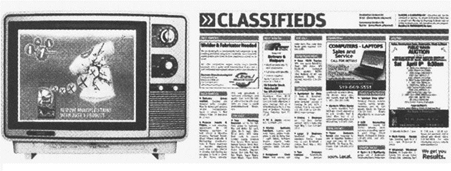 Advertisements on the television and in the newspaper
Television, internet, text messages,
banners, billboards, hoardings and announcements. Thus, advertising can be
defined as the act of calling public attention to one's products, services,
needs, etc., especially by paid announcements through the mass media.
PURPOSE OF ADVERTISING
As early as 1836, French newspaper La
Presse included paid advertising in its pages. This made it possible for the
newspaper to lower its price. Doing this, its readership increased
Know a Little More
HD television came as a relief for
television viewers as besides offering high definition it also offered
advertisement-free programmes.
And thus there was an increase in its
sale. This explains why newspapers and magazines have entire pages devoted to
advertisements and why there are so many advertisements more...
Advertisements on the television and in the newspaper
Television, internet, text messages,
banners, billboards, hoardings and announcements. Thus, advertising can be
defined as the act of calling public attention to one's products, services,
needs, etc., especially by paid announcements through the mass media.
PURPOSE OF ADVERTISING
As early as 1836, French newspaper La
Presse included paid advertising in its pages. This made it possible for the
newspaper to lower its price. Doing this, its readership increased
Know a Little More
HD television came as a relief for
television viewers as besides offering high definition it also offered
advertisement-free programmes.
And thus there was an increase in its
sale. This explains why newspapers and magazines have entire pages devoted to
advertisements and why there are so many advertisements more... 


You need to login to perform this action.
You will be redirected in
3 sec