Current Affairs 9th Class

Heron's Formula  
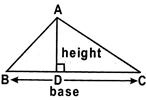
  • Area of a triangle \[=\frac{1}{2}\times \operatorname{base}\,\times \,height\]
       
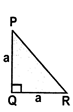
  • Area of a right angled isosceles triangle with perpendicular sides each equal to 'a' units\[=\frac{1}{2}{{a}^{2}}\] sq. Units.
   
  • Heron's formula:
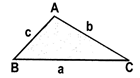
            Area of a triangle \[=\sqrt{s\left( s-a \right)\left( s-b \right)\left( s-c \right)}\]where a, b, c are the sides of the triangle and             s = semi perimeter i.e., half the perimeter of the triangle =\[=\frac{a+b\text{ }+c}{2}\]         Note: Heron's formula can be used when three sides of triangle are given and can be applied to any triangle.                                                    
  • Area of an equilateral triangle with each side equal to 'a' units \[=\frac{\sqrt{3}}{4}{{a}^{2}}\]sq. units.
  • Area of an equilateral triangle\[=\frac{{{h}^{3}}}{\sqrt{3}}\]sq. units where altitude\[h=\frac{\sqrt{3}}{2}a\] units.
  • Area of a quadrilateral whose sides and one diagonal are given, can be calculated by dividing the quadrilateral into two triangles and using the Heron's formula.
 
  • Three positive integers a, b and c such that is\[{{c}^{2}}={{a}^{2}}+{{b}^{2}}\] called a Pythagorean triplet.
   

Surface Areas and Volumes  
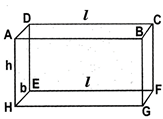
  • Cuboid: Let be the length, V the breadth and 'h' the height of a cuboid, then
            (i) Sum of the lengths of the 12 edges of a cuboid                                                             (ii) Lateral surface area \[=2\left( l+b \right)\times h\]             (iii) Total surface area \[=2\left( lb\text{  }bh\text{ }+\text{ }hl \right)\]                 (iv) Diagonal  \[=\sqrt{{{l}^{2}}+{{b}^{2}}+{{h}^{2}}}\]                                     (v) Volume                          
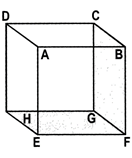
  • Cube: If 'a' is the edge of a cube, then
            (i) Sum of the lengths of the 12 edges of a cube = 12a                            (ii) Lateral surface area \[=\text{ }4{{a}^{2}}\]             (iii) Total surface area \[=\text{ }6{{a}^{2}}\]             (iv) Diagonal \[=\sqrt{3}\]             (v) Volume\[=\text{ }{{a}^{3}}\]                          
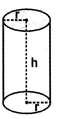
  • Cylinder: If 'r' is the radius and 'h' is the height of a cylinder, then
            (i) Curved or lateral surface area \[=2\pi rh\]             (ii) Total surface area \[=\text{ }2\pi r\left( h+r \right)\]             (iii) Volume\[=\pi {{r}^{2}}h\]                                                                                                                                     
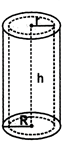
  • Hollow cylinder: A solid bounded by two co-axial cylinders of the same height but with different radii is called a hollow cylinder.
              If 'r' is the radius of the inner cylinder 'R' is the radius of the outer cylinder and 'h' is the height of the hollow cylinder then             (i) Curved or lateral surface area\[=2\pi r\left( R+r \right)h\]             (ii) Total surface area\[=\text{ }2\pi \left( R+r \right)\left( h+R-r \right)\]             (iii) Volume \[=\pi h\left( {{R}^{2}}-{{r}^{2}} \right)\]                            
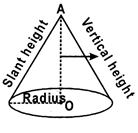
  • Cone: If \['l'\]is the slant height,\['r'\] is the radius of the base and 'h' is the vertical height of a cone, then                 
  • Curved surface area\[=\pi rl\]
  • Total surface area \[=\pi r\left( l+r \right)\] (iii) Volume =\[\frac{1}{3}\pi {{r}^{2}}h\]                                                                                       
  • Slant height, \[l=\sqrt{{{h}^{2}}+{{r}^{2}}}\]
                           
  • Sphere: A sphere is a solid which can be defined as the set of all points in space which are equidistant from a fixed point, If 'r' is the radius of a sphere, then
  • more...

Statistics  
  • Statistics, a branch of mathematics is useful in the collection, classification and interpretation of data.
 
  • The word statistics is used in two different senses:
            (i) In plural sense, statistics means data.             (ii) In singular sense, statistics is the science which deals with the collection, presentation, analysis and interpretation of some numerical data.  
  • Data: The word data means information in the form of numerical figures or a set of given facts.
 
  • A statistical data is collected by a single person or by a group of persons having uniform approach.
            Someone who carries out the job of collection of data is called an investigator.  
  • Primary data: The data collected for a definite purpose by an investigator or a group of investigators directly, is called primary data.
 
  • Secondary data: The data collected from a source which already has the information stored, is called secondary data.
 
  • Raw data: An information of facts and figures collected for a definite purpose in any manner is termed as raw data.
 
  • Tabulation: Arranging the data in a systematic way in tabular form is called tabulation.
 
  • Observation: Each numerical figure in a data is called an observation.
 
  • Frequency: The number of times a particular observation occurs in the data is called its frequency.
 
  • Range: The difference of the greatest and the least values of the given data is called its range.
 
  • To determine the frequency of each distinct entry of the data, we draw tally marks in the form of small vertical lines, called bars.
 
  • Grouped frequency distribution: When a data has a large number of values (entries) and most of them are distinct, it becomes inconvenient to present it in the form of ungrouped frequency distribution. The data is condensed into a finite number of groups called classes of the data. Presenting data in this form is called a grouped frequency distribution.
 
  • Frequency of a grouped data: The number of entries of the data having their values lying in a class is defined as the frequency of the class. The table, in which the corresponding frequencies are written against each class, is called a frequency distribution of the given data.
                Types of frequency distribution: There are two types of grouped frequency distributions of a data. They are:             (i) Inclusive method or discrete form.             (ii) Exclusive method or continuous form.  
  • Lower limit and upper limit: In the classes 0-9, 10-19,20 - 29 and 30-39, the values 0,10,20 and 30 are called the more...

Probability  
  • Random experiment:
            An experiment in which all possible outcomes are known and the exact outcome cannot be predicted in advance is called a random experiment.             e.g. (1) Tossing a coin.    (2) Rolling an unbiased die.  
  • Sample space:
            The set S of all possible outcomes of a random experiment is called the sample space.             e.g., (1) In tossing a coin, sample space (S) = {H, T}             (2) In rolling a die, sample space (S) = {1,2,3,4,5,6}  
  • Probability:
            Probability is a concept which numerically measures the degree of certainty of the occurrence of events.  
  • Definition of probability:
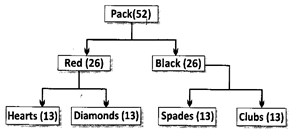
            In a random experiment, let S be the sample space and let E be the event. Then probability of occurence of E \[=P\left( E \right)=\frac{n\left( E \right)}{n\left( S \right)}\] , where n (E) is the number of elements favourable in E, and n(S) is the number of distinct elements in S.             Note:    (1) 0                                \[\le\]              P (E)                                \[\le\]              1             (2) If P (E) =1, then the event E is called a certain event and if P(E)=0 then the event E is called an impossible event .               Important points:             (a) A coin has 2 sides - one side is head (H) and the other side is tail (T).             (b) A die is a cube with 6 faces - with numbers (or dots) 1 to 6 on each face.             (c) Description of a normal pack (or deck) of cards (52):              The cards in each suit are Ace(A), King(K), Queen(Q), Jack(J), 10,9,8,7,6,5,4,3 and 2. The cards A, J, Q and K are called honours and the cards 2,3,4,5,6,7,8,9 and 10 are called numbered cards. The cards J, Q and K are called face cards.  

  Motion   Synopsis  
  • Rest and motion: If the object's position does not change with respect to time and surroundings, it is said to be at rest. If the position of an object changes with time and surroundings, it is said to be in motion.
 
  • Displacement: The change in the position of a particle during a time interval is called its displacement in that time interval.
 
  • Scalar quantity: A quantity that has only magnitude but no direction is called a scalar quantity, e.g., distance, speed, etc.
 
  • Vector quantity: A quantity that has both magnitude and direction is called a vector quantity, e.g., displacement, velocity, etc.
 
  • Speed: The speed of an object is the distance traversed by it in a given interval of time.
 
  • Average speed :The average speed of a body for the complete journey is given by:
          \[Average\,\,\,speed=\frac{Total\,\,dis\tan ce}{Total\,\,time\,\,taken}\]  
  • Uniform speed: lf an object covers equal distances in equal intervals of time (however small the time intervals maybe), it is said to be moving with a uniform or constant speed.
 
  • Velocity of an object is the speed of the object as well as the direction of its motion. Velocity changes if either speed or the direction of motion changes.
 
  • Acceleration of a moving object is the change in its velocity per unit time.
 
  • Distance-time graph of an object moving with uniform speed is a straight line.
 
  • Velocity-time graph: If an object moves with a constant acceleration in a straight line, its velocity-time graph is a straight line.
 
  • Circular motion: A particle moving in a circular path changes its direction continuously and hence, it is in acceleration. The speed of a body in circular motion may be constant but the velocity is never constant because of the constant change in direction.
 
  • Mathematical equations:\[S=vt\] (S is the distance, v is the speed, t is the time) \[V=u+at\] (u is the initial velocity, v is the final velocity, a is the acceleration (assumed/constant)).
         \[S=ut+\frac{1}{2}a{{t}^{2}}\]         \[{{V}^{2}}={{u}^{2}}+2aS\]         Where \['v','u','s'\] and 'a' have their usual meanings.  

  Force and Laws of Motion   Synopsis  
  • Force
Force is that cause which produces an acceleration in the body on which it acts. A force or a set of forces can change the speed of body, change the direction of the motion of the body and change the shape of the body.  
  • Balanced and unbalanced forces
If a set of forces acting on a body produces no acceleration in it/then the forces are called balanced forces. If the set of forces produces an acceleration, they are said to be unbalanced forces.  
  • Types of forces Contact force.     2. Non-contact force.
 
  • Newton's first Law of Motion
A particle remains at rest or moves in a straight line with a constant speed unless it is compelled to change that state by an external unbalanced force. The first law of motion gives the definition of inertia.  
  • Inertia of rest: The tendency of a body to continue in its state of rest is due to inertia of rest, e.g., when a bus starts suddenly, the passengers fall backwards.
Inertia of motion: The tendency of a body to continue in its state of motion is due to inertia of motion, e.g., a bicycle is observed to move forward even when pedalling is stopped. Inertia of direction: The tendency of a body to continue to move with uniform motion in a linear direction.  
  • Newton's Second Law of Motion
The rate of change of momentum of a body is directly proportional to the applied force and takes place in the direction in which the force acts. Mathematically \[F\propto \frac{\Delta P}{\Delta t}\Rightarrow F=k\left[ \frac{{{P}_{2}}-{{P}_{1}}}{\Delta t} \right]\Rightarrow k\left( \frac{mv-mu}{\Delta t} \right)=k\left( m\left( \frac{v-u}{\Delta t} \right) \right)=km\left( \frac{\Delta v}{\Delta t} \right)F=kma\] The value of the constant of proportionality can be taken as 1 when a unit of forces is chosen in such a way that it produces a unit acceleration by a unit mass then F = ma.  
  • Impulse: Impulse is defined as the product of force which acts on a body and the time for which the force acts. When a large force acts on a body for a very short duration of time then this large force is called impulsive force.
   

  Gravitation and Pressure   Synopsis  
  • Gravitation: The gravitational force of the earth is responsible for holding the atmosphere above the earth and it also keeps us firmly on the ground.
 
  • Universal Law of Gravitation: Everybody in the universe attracts every other object with a force which is proportional to the product of their masses and inversely proportional to the square of the distance between them. The direction offeree is along the line joining the centres of the two bodies.
 
  • Free Fall: The falling of a body from a height towards the earth under the gravitational force of earth (with no other forces acting on it) is called a free fall.
  Motion of bodies under the influence of gravitational force of the earth. Since, the freely falling bodies fall with uniformly accelerated motion, the three equations of motion derived earlier for bodies under uniform acceleration can be applied to the motion of freely falling bodies.  
General equations of motion   Equations of motion for freely falling bodies
\[v=u+at\] Changes to \[V=u\pm gt\]
\[S=ut+\frac{1}{2}a{{t}^{2}}\] Changes to \[h=ut\pm \frac{1}{2}g{{t}^{2}}\]
\[{{v}^{2}}-{{u}^{2}}=2as\] Changes to \[{{v}^{2}}-{{u}^{2}}=\pm 2gh\]
 

  Work, Energy and Power   Synopsis  
  • Work
Work is said to be done only when a force displaces an object. The amount of work done by a body is measured as the product of magnitude of the force applied and the distance moved by the body in the direction of the force. Work is a scalar quantity.   Work = force \[\times \] displacement of the body, W = F \[\times \] S W = FS \[Cos\,\,\theta \] Where 'S' is the displacement of the object and \[\,\theta \] is the angle between the force and displacement. W = FS if the displacement is along the force then \[\,\theta =0\,\,and\,\,cos\,\,\theta =1\] W = -FS if the displacement is opposite to the force then \[\theta ={{180}^{{}^\circ }}\]and \[Cos\,\theta =-1\]. If the displacement is perpendicular to the force, then the work done is zero\[(\theta =90{}^\circ ,\,\,\cos \,\theta =0)\]  
  • Energy: The capacity to do work is called energy. It is a scalar quantity and its units are the same as that of work.
  Types of energy: Kinetic energy: The energy possessed by a body by virtue of its motion is called kinetic energy. If a body of mass m is moving with a velocity v, then its kinetic energy is given as \[K.E.=\frac{1}{2}m{{v}^{2}}\] Potential energy: The energy possessed by a body by virtue of its position is called potential energy. If a body of mass W is lifted to a height 'h' against gravity 'g; then its potential energy is given as P.E.= mgh Potential energy is of two types: (i) Gravitational potential energy: The potential enegrgy of an object due to its height above the earth's surface is called its gravitational potential energy.   (ii) Elastic potential energy: A stretched or compressed object such as a spring or a rubber band has elastic potential energy.  
  • Relation between work and energy: Work done by external forces on a system is equal to the increase in the energy of the system.
 
  • Principle of conservation of energy: According to the law of conservation of energy, one form of energy can be changed into another form of energy. Amount of energy lost in one form should be equal to the amount of energy gained in another form.
 
  • Power: Work done per unit time is called power. Watt is the unit of power.
Horse Power = 746 W  

  Sound   Synopsis  
  • Sound:
Sound is a form of energy that produced due to vibration s of different object  
  • Sound is a wave motion produced by a vibrating source. A medium is necessary for its propagation as it is a mechanical wave. Sound cannot travel in Vacuum. The vibration source produces compression and refraction pulses which travel one after the other in the medium. Sound wave are longitudinal waves.
 
  • The speed (v), frequency (f) and the wavelength \[(\lambda )\]of a sound wave are related by the equation:
\[V=f\lambda \]  
  • Characteristics of sound:
Pitch - Depends on the frequency. Higher the frequency, higher is the pitch Loudness - Depends on amplitude, More the amplitude, more is the loudness. Quality - Quality depends on the combination of harmonics produced by different instruments  
  • Mathematical equations involving wavelength\[(\lambda )\], time period (T), frequency (f) or (n)
(i) \[f=\frac{1}{T}\]  (ii)\[\lambda =vT\]   (iii) \[v=f\lambda \] Where f is the frequency T is the time period,\[\lambda \] is the wavelength and v is the velocity of the wave  
  • Reverberation
Echo is the sound heard after reflection from a rigid obstacle (such as a cliff, a hill side wall of a building etc.) For example, echo is produced when you shout into a well inside an empty hall or inside a dome.  
  • Sonar
Sonar is a device that usess ultrasonic waves to measure the distance direction and speed of underwater objects.  
  • Audible range of frequencies: An average person can hear sounds in the frequency range of 20Hz-20kHz
 
  • Infrasonic sound: Some vibrations produce sounds below the normal hearing range. These are known as infrasonic sounds (below 20Hz) Earthquakes underground nuclear explosions and tides, all produce infrasonic sound.
 
  • Ultrasonic sound: Vibrations above the normal hearing range produce ultrasonic sound (above 20,000 Hz) Many animals like bats dolphins, dogs produce and hear such sounds.
 
  • Sonic boom: An object travelling faster than the speed of sound is said to travelling at at supersonic speed. A source of sound travelling at supersonic speed causes the formation of shock waves. When a shock wave reaches a person, he hears a sharp and loud sound called the sonic boom.
   

  Matter in our Surroundings   Synopsis  
  • Matter exists in three states, namely, in the solid, liquid and gaseous states.
 
  • The physical properties of solids are density, specific gravity, hardness, odour, colour, point/freezing point, viscosity, solubility and heat conduction.
Particles are arranged in a regular pattern. They are closely packed and have fixed positions. They do not move freely but only vibrate and spin around their fixed positions. They are held together by strong attractive forces and have the least amount of energy.  
  • The properties of liquids are surface tension, adhesion, cohesion, viscosity, buoyancy and
Vaporisation Particles are not arranged in a regular pattern. They are further apart and do not have fixed positions. They move freely and around one another. They are held together by attractive forces which are weaker than those in the a moderate amount of energy.  
  • They properties of gases are pressure, volume, temperature, kinetic energy and speed.
Particles are not arranged in a regular pattern. They widely spaced and do not have fixed positions. They move freely and randomly at high speeds. They have very weak attractive forces between them and have the greatest amount of energy.  
  • Gases possess the property of intermixing with one another through diffusion.
 
  • Heat can cause matter to change from one state to another.
 
  • The kinetic energy of particles depends on the heat and pressure of the matter. The energy Will determine the movement of particles in the matter.
 
  • As the state of matter of matter changes there is a transfer of energy, heat is either absorbed or released.
 
  • Changes in the states of matter are reversible processes.


You need to login to perform this action.
You will be redirected in 3 sec spinner