POLLUTION AND CALAMITIES
FUNDAMENTAL
Pollution is deterioration of environment due unwanted and undesirable substances present leading to affect health and day to day life.
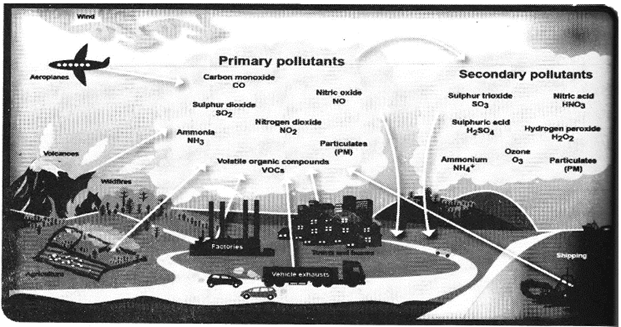
Unwanted and undesirable substances present in air, water, and soil are pollutants such as sulphur dioxide (SO2), lead oxides, smoke dust particles etc.
POLLUTION
Air pollution
Contamination of air with harmful gases and substances.
Water pollution
Presence of undesirable substances in the water
Soil pollution
Deterioration of soil with harmful chemicals
Noise
Unwanted and undesirable sound > 80dB
Radioactive pollution
Radiation
AIR POLLUTION → CAUSES
Man made
Burning of fossil fuel.
Smoke from factories.
Release of harmful gases from cars and other vehicles.
Deforestation
Natural
Volcanic eruption
Forest fire
Deforestation is the major cause of Air pollution as plants and trees act as natural purifiers.
Volcanic eruptions causes concentration of carbon dioxide, nitrogen more...
SAFETY AND FIRST AID
FUNDAMENTAL
Safety measures are important to avoid accidents and minimize their after effects.
Safety on the road is more important now a days because of the rapid increase in number of vehicles, road sign and signals are meant for safety. Traffic signals control the flow of traffic, and ensure smooth movement of vehicles
First aid: is the first medical help given to an injured person before reaching to a doctor. The most important during first aid to assure the injured and stay calm, don't create a panic situation.
Cuts and scratches: Germs can enter a body through cuts or wounds and causes infection
The wound should be washed through to remove the dirt and foreign bodies of the wound
Clean the affected area with antiseptic solution
Place a sterile gauze and thick pad of cotton on the wound and give pressure bandage it will help in controlling of bleeding.
A Tourniquet: can be used. This is a bandage lightly tied over the wound to stop bleeding
Wrap: a sterile gauze bandage around the wounded area
For nose bleeding: keep the patient up right in a comfortable position with this head held back. Pinch the nose firmly and breath through month.
Keep the ice-pack on nose.
Avoid pickling and blowing of the nose.
If bleeding is heavy reach to doctors, preferably to a specialist E.N.T doctor.
FRACTURES
A cracks or break in a bone is called a fractures - keep the patient calm and comfortable, apply a splint to give support to the broken bone and try to avoid unnecessary movement then send to the orthopedic doctor. A made from a triangular price of cloth may be used for support
BURN
Burn injury can be caused by hot objects, fire steam, boiling water, cracker electric current and chemicals like acids.
SUPERFICIAL BURNS
These are very painful. Let running cold water/ late water flow out on the bum till pain reduces. Apply any antibiotic lotions and ointments to prevent infections.
DEEP BURN
Cover the bum area clean (sterile piece) with gauze to prevent it form germ and dust reach to proper open medical setup. If fire has been caused by electric fault if should be turned off immediately.
Don't throw water on It. it may causes electric shock, use a fire extinguisher or sand
ANIMAL BITES
Animal bites are common. Wash the wound with soap and mnning water for more than 15 minutes, so that the germs will be washed away without being attached to the injured tissue. Dog, monkey, cat, cow, buffalo etc. can cause rabies so anti rabies serum and vaccine must be given as early as possible and would should not be stitched/bandaged.
SNAKE BITES
The more...
The system of Numeration, developed by Romans is called the Roman numerals system. In Roman numerals system there are seven distinct symbols. viz I, V, X, L, C, D and M.
Roman symbols and their corresponding Hindu-Arabic numbers
A fraction is a number representing a part of a whole
The fractions One-third, Three-fifths, Two-sevenths are written as: \[\frac{1}{3},\frac{3}{5},\frac{2}{7}\]respectively.
The lower part of a fraction, which indicates the number of equal parts into which the upper part is divided, is called denominator. The upper number, denotes the number of parts considered of the whole, is called numerator.
Types of Fraction
Proper Fraction: A fraction whose numerator is less than the denominator is called a proper fraction.
Example: \[\frac{1}{3},\frac{2}{3},\frac{4}{5}\]
In the above fractions, the numerators 1, 2, 3, are less than denominators 3, 3, 5 respectively.
Improper fraction: A fraction whose numerator is more than or equal to denominator is called improper fraction.
Example:\[\frac{5}{3},\frac{6}{5},\frac{7}{4},\frac{7}{7}\] etc.
Mixed Fraction: A combination of a whole number and a paper fraction is called a mixed fraction
In this chapter, we shall study comparing quantities like ratio and proportion, profit and loss, discount simple interest, distance speed and time.
Ratio and Proportion
Ratio is a method of comparing two quantities of the same kind by division.
When two ratios are equal, they are said to be in proportion.
If two ratios are to be equal or are in proportion, their product of means should be equal to the product of extremes.
Example: If a: b: c: d then the statement ad = be, holds good.If a: b and b: c are in proportion such that \[{{b}^{2}}\]=Ac than b is called the mean proportional of a: b and b: c
Multiplying or dividing terms of the ratio by the same number gives equivalent ratios.
In geometry, there are three basic terms point, line and plane.
Point: A point does not have length, breadth and height. It is a mark of position and is represented by a dot.
Line: A line normally refers to a straight line which extends indefinitely in both the directions. Thus, it has length but no breadth and no height.
Example: If you hold a thread taut between two hands, it represents part of a line.
Plane: A plane has two dimensions, length and breadth, but no height.
Example: A piece of paper represents a plane, Top of a table represents plane, etc.Passing through a point, an infinite number of lines can be drawn.\[{{l}_{1,}}{{l}_{2.................}}{{l}_{n}}\] All pass through ?P?These lines are also called CONCURRENT lines and the point P is called point of concurrence.
Two lines in a place are either intersecting or parallel
Perimeter, the length of the sides enclosing the figure is called its perimeter.
Perimeter of square\[=4\times \,\,side=4a\]Perimeter of rectangle = 2 (length + breadth)\[=2(l+b)\]Perimeter of triangle = sum of its sides\[=(AB+BC+CA)\]
Area: The area of any figure is the plane space occupied by it or the amount of surface enclosed within its boundary lines.
It is measured in square units i.e. Square meter\[({{m}^{2}})\], Square centimeter \[(c{{m}^{2}})\]etc.
Area of square\[={{(side)}^{2}}={{a}^{2}}\,\,sq.\,\,unit\]Area of rectangle= length \[\times \] breadth\[=l\times b\]Sq. unit.
The standard unit of length is meter and it is denoted by m.
The other units of length are Millimeter (mm). Centimeter (cm) and Decimeter (dcm) which are lower units of length. Whereas Decameter (dm), Hectometer (hm), Kilometer are higher units.
Measurement units of length from lower level to higher level

 FUNDAMENTAL
Pollution is deterioration of environment due unwanted and undesirable substances present leading to affect health and day to day life.
Unwanted and undesirable substances present in air, water, and soil are pollutants such as sulphur dioxide (SO2), lead oxides, smoke dust particles etc.
POLLUTION
 FUNDAMENTAL
Safety measures are important to avoid accidents and minimize their after effects.
Safety on the road is more important now a days because of the rapid increase in number of vehicles, road sign and signals are meant for safety. Traffic signals control the flow of traffic, and ensure smooth movement of vehicles