s JEE Main, JEE Advanced, CBSE, NEET, IIT, free study packages, test papers, counselling, ask experts - Studyadda.com

Current Affairs 5th Class

Our Universe   The universe is vast. The solar system forms a very small part of the universe. Our earth is one of the eight planets of the solar system. Yuri Gagarin was the first man to go into space. Valentina Tereshkova was the first woman to go into space. Rakesh Sharma was the first Indian man and later Kalpana Chawla became the first Indian woman to go into space. Related image Solar System   Moon As the earth moves around the sun, it is accompanied by the moon. Even though the moon is earth's nearest neighbour in space, it is 3,84,400 km away from the earth’s The moon is 4500 million years old, the same age as the earth. The moon is called the earth's natural satellite because it revolves around the earth. Why does the moon shine at night? The moon shines because it reflects the sun's light falling on it. The surface of the moon is made up of plains, valleys and mountains. There are big holes called craters all over the moon. These craters are round and deep. A dark grey dust covers the surface of the moon. Americans Neil Armstrong, Edwin Aldrin and Michael Collins were the first people to visit the moon. They landed on the moon on 21 July 1969 in their spacecraft Apollo 11. Neil Armstrong was the first person to step on the moon. Image result for MOON png Moon   The Moon and Tides The rising and falling of the level of water in the sea are called tides. Tides are caused by the gravitational pulls of the moon and the sun. The moon attracts the ocean water with stronger force of attraction than that of the sun, because the moon is much closer to the earth than the sun.   Eclipse An eclipse is a shadow that makes the sun or the moon totally or partially invisible for some time. The sun is the source of light and the earth and the moon are the objects that come in the path of this light and cast their own shadows. As the earth and the moon keep moving, their positions keep changing. Thus, their shadows also keep changing.   Solar Eclipse Sometimes the moon comes between the sun and the earth. When this happens, the moon. obstructs the light of the sun and casts its shadow on the earth. The people living in this part of the earth can see only a part of the sun or not see it at all. This is a solar eclipse. Once the moon moves out of this position, the sun can be seen again. If the complete disc of the sun is covered by the shadow of the moon, it is called a total solar eclipse. If more...

Light and Sound   Light Light is a form of energy which enables us to see an object. Sun is the main source of light on our earth. Image result for SUN Sun   Luminous Objects Sun, candle, diya and lamp are examples of objects that produce light. These are called Iuminous objects. Related image                                        Diya                                                                 Lamp   Non luminous Objects The objects that do not produce Tight are called non-luminous objects. Paper, kite and table are examples of non-luminous objects.                     Image result for kite clipart                     Paper                                       Kite                                    Table   Shadow       Light always travels in a straight line. When there is some obstruction in the path of light, we see a shadow. Light is always needed for a shadow to form. Shadows always form on the opposite side of the source of light. Shadows can never form in total darkness. Some objects cast dark shadows while some cast faint shadows. Sometimes shadows are smaller, and sometimes they are bigger than the actual size. Long shadows are formed in the morning and the evening. Short shadow is formed at noon.   Opaque Objects Wood and metal are examples of opaque objects. No light can pass through such objects. So they form clear and dark shadows when they are placed in front of a source of light.   Transparent Objects These objects allow almost all light to pass through them. So transparent objects form very faint shadows (or no shadow at all). Plain glass is an example of a transparent object.   Translucent Objects Butter paper is an example of a translucent object. Such objects block only a part of the light that passes through them. So they throw a faint shadow.   Sound A wave of vibrations that spreads from its source. Vibration is the back-and-forth motion of an object. Sound is produced when we talk, when we strike a steel tumbler with a spoon. Our tongue helps us to make sound. Some sounds are soft, some are loud. Some sounds are pleasant and some are unpleasant.   Noise Sound that is loud and unpleasant is called noise. Too much of noise is harmful for our health. Therefore, we should speak softly. We should play television, music system, etc. in low volume so as not to disturb our family and neighbours.
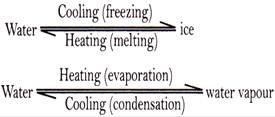
Matter     Matter Matter i            s anything that occupies space and has weight. It is classified into three categories. Solid, liquid and gas. All matter can be split into tiny units that are not visible to the naked eye. These small units are called molecules. Salt molecule is the smallest particle of salt.   Atom A molecule has smaller units called atoms. Atoms are building blocks of matter. There are 117 kinds of atoms known to us. Atoms of same kind form elements. Atoms of different kinds combine and form compounds. Molecules are constantly in a state of motion and are attracted towards each other. In solids, molecules are tightly packed. In liquids, molecules are less closely packed compared to solids. In liquid, molecules can move freely and can flow. That is why a liquid has definite volume but no definite shape. In gases, the distance between molecules is large. The molecules in a gas move faster than the molecules in a solid or a liquid. Gas has no definite shape and volume.   Combination of States of Matter States of matters may be combined as follows:   Solid in water Sugar and salt are soluble in water. The molecules of these substances occupy the space between the molecules of water.   Liquids in water When two liquids mix in each other, liquids are said to be miscible. Alcohol is miscible with water whereas kerosene is immiscible with water.   Gases in water Carbon dioxide, nitrogen, oxygen and ammonia dissolve in water. Water in oceans and rivers contains dissolved oxygen and nitrogen. When water is boiled, bubbles are formed of gases which are dissolved in water. Aerated drinks contain carbon dioxide.   Change of State Matter changes its state with change in temperature and pressure. If we heat ice, it changes into water that is state changes from solid to liquid.   Physical change A physical change is a temporary change in which no new substance is formed. Physical changes can also be reversed. For example,                                           These changes involve change:
  • In the state of matter
  • That are temporary
  • That can be easily reversed
  Chemical change In a chemical change, on heating or cooling we get a new substance that cannot be changed into the old one. For example, burning of paper, rusting of iron, etc. Chemical changes: (i) are permanent. (ii) cannot be reversed. (iii) result in the formation of new substances.               

Reasoning and Aptitude   Introduction Learning process is dependent on ones ability to think logically and reason quickly and effectively. So Reasoning and logic skills are an important part in our progress as these skills are very useful in our day to day life. In this chapter, we will learn various problems related to reasoning and aptitude.   Problems Based on Patterns Pattern is a list of numbers or letters that follows a certain sequence of a certain rule. To solve them all we have to do is figure out the pattern and come up with the next logical number or letter of the sequence.   Example: Which number will replace the question mark (?) in the number pattern given below?   (a) 18                           (b) 22 (c) 16                           (d) 14 (e) None of these   Answer (c) Explanation: Pattern followed in  is Q = + 2   Or, So, ? =  Hence, missing number is 16.   Figure Pattern Figure pattern is a collection of figures that follows a certain sequence or a certain rule.   Example: How many squares will be there in pattern (31)?     (a) 103                         (b) 94 (c) 98                           (d) 89 (e) None of these   Answer (b)   Explanation: Number of squares in Pattern (1) = Number of squares in Pattern (2) = Number of squares in Pattern (3) = Number of squares in Pattern (4) = Therefore, Number of squares in Pattern (31) =    Problems Based on Alphabet Test and word   Formation Alphabet test is one of the most common topic of reasoning where we come across various types of problems as follows:   Example: Find out the word which cannot be made from the letters of the given word. PROGRAMMING (a) Margin                    (b) Ranger        (b) Paring                    (d) Ingram (e) None of these   Answer (b) Explanation: In more...

Comprehensions based on General Topic   Introduction In reading comprehension, there is a passage. You have to read the passage carefully and answer the questions based on it. Some examples are given below to develop your understanding.  
  •                         Example 1
  Directions: Read the following passage carefully and answer the questions that follow:   When I was young, I decided to slip a dead mouse into Mrs Pritchett's jar of sweets. I told my friends, "When she puts her dirty hand in the jar to grab a handful of sweets, she'll grab a stinky mouse instead. The other four stared at me in wonder. They slapped me on the back. We all danced around the classroom. "We'll do it today!" they cried. "We'll do it on the way home! You had the idea', they said to me, 'so you can be the one to put the mouse in the jar.   Peter handed me the mouse. I put it into my pocket. I?ve got a penny", Peter said, "So I'll ask for one lollipop and a chocolate. And while she turns away to get them, you slip the mouse quickly into the jar." Feeling very nervous, we entered the shop. Mrs. Pratchett stood .behind the counter. "One chocolate please". Peter said to her, holding out his penny.   When I saw Mrs. Pratchett turn her head away for a couple of seconds to look for the chocolate, I lifted the glass lid of the jar standing in front of me and dropped the mouse in. Then I replaced the jar as silently as possible. My head was thumping like mad and my hands had gone sweaty.   1.            Mrs. Pratchett owned a: more...

Comprehension Based On Stories  
  •                        Example 1
  The Heaven and Hell Once a man fell asleep under a tree and he had a dream. In the dream he ventilated God his curiosity to know about Heaven and Hell.   Thereafter, God promised him his desired realization.  He said, both places are exactly the same, only ones feeling matters. The man did not understand anything and quietly followed God.   After a long walk, they reached a place where many delicious dishes were being cooked. But, all the creatures had non-flexible hands as a result of which they were unable to eat. All of them were dying with hunger. After taking a look at their miserable condition, the duo walked away. God pointed out the place as being Hell. They walked further and arrived at another place.   Surprisingly, the situation was exactly the same-the same dishes and the same kind of creatures. But here, one creature stretched his hand to feed his neighbour and standing in a circle everybody satiated themselves.   The man did not require any more explanation of this place of being Heaven. He could now realise God's words. It's not the place that makes a Heaven or Hell, compassion matters.   1.          The man was _____ to know about heaven and hell. (a) happy                           (b) angry (c) curragues                    (d) curious (e) None of these   2.          The situations in Heaven and Hell were: (a) Same                            (b) Boring (c) Different                     (d) Amazing (e) None of these   3.          It is not the place that makes Hell or Heaven, ___ matters. (a) Compassion                (b) Jealousy (c) Hatred                           (d) All of these (e) None of these   4.          The creatures in both hell and heaven had: (a) Scanty food                  (b) Lack of cutlery (c) Non-flexible hands (d) A miserable condition (e) None of these  
  •                        Example 2
  The True Friends The four year old Pierre lived in a remote village near Paris. more...

Classification   Classification is the process of differentiating one object from another object or a group of objects.   Directions: In the following questions, identify which one is different from rest of the three.                                                                         1.                (a) Breathing              (b) Singing                            (c) Playing                 (d) Writing                            (e) None of these Ans. (a) Only breathing is natural action.   2.                (a) Saturn                  (b) Eros (c) Neptune              (d) Venus (e) None of these Ans. (b) All the rest are planets.   3.                (a) Algebra                     (b) Geometry (c) Mathematics              (d) Trigonometry (e) None of these Ans. (c) All the rest are branches of Mathematics.   4.                (a) Administration           (b) History (c) Civics                       (d) Geography (e) None of these Ans. (a) All the other terms are subjects-   5.                (a) Grape                       (b) Cashewnut (c) Pineapple                  (d) Apple (e) None of these Ans. (b) All the rest are fruits.  

Analogy   Analogy means similarity between two things or you can say a relation between the two. Below we are giving types of relations which helps you in understanding analogy.     Instrument and Measurement:         
S.NO Instrument Measurement
1. Scale Length
2. Seismograph Earthquakes
3. Thermometer Temperature
4. Balance more...
Distinguishing between Real and Imaginary   Directions: In this chapter, we will discuss the facts or statements which may be real imaginary. In our daily life, we hear many lines which are not possible.   For example: Serena stands on sun. As we know that no one can stand on sun as it is very hot and as well as far it is awe from the Earth. Some examples are given below. Read them carefully.  
  •                         Example 1
Which one of the following statements or facts about chocolates is imaginary?  (a) All chocolates are not sweet. (b) Some chocolates are liquid.                                               (c) Chocolates are poison for cats. (d) Chocolates are sold in various sizes in market. (e) None of these   Ans. (c) "Chocolates are poison for cats" is an imaginary statement about chocolates. As know that no cat will die after eating chocolates till poison is not mixed with it Chocolates never harm an animal in such a bad way.  
  •                     Example 2
Which one of the following statements about shampoos is imaginary? (a) All shampoo's are eatables. (b) Shampoos are used to wash the hair.                                   (c) Some shampoos are liquid. (d) Some shampoos are black in colour.- (e) None of these   Ans. (a) No shampoo is eatable, so statement (a) is an imaginary statement.  
  •                      Example 3
            Read the sentence I,II, and III carefully: (I) Face cream are mixed with vegetable to make them tasty. (II) Face cream are generally light in colour. (III) Face cream protect our Face from sunlight.   Which of the statement are real? (a) I only (b) I and II only (c) I and III only (d) II only (e) None of these   Statement (II) and (III) are real while statement (I) is an imaginary as face cream are different From the cream used to more...

Distinguishing between Facts and Opinions   In this section, we will differentiate between facts and opinions and also find that whether the opinion follows the given fact. Some examples are discussed below to make you understand.  
  •                        Example 1
  Three sentences are given below. You have to identify which sentence is a fact and which is an opinion.   I:  No new taxes are proposed in the revised budget. II: The country has a balanced economy. Ill: The country has a surplus.   Select the answer from the given choices: (a) I - fact, II - opinion, III - opinion (b)   I - opinion, II - fact, III - fact (c)  I - fact, II - opinion, III - fact (d) I - fact, II - fact, III - opinion (e)     None of these Ans. (a)  
  •                      Example 2
  Three sentences are given below. You have to identify which sentence is a fact and which is opinion. I:  After this amendment to the Constitution, no child below the age of 14 years will be employed to work in any factory or mine or engaged in any other hazardous employment. II: Before this amendment, children below 14 years were employed to work in factory or a mine. Ill: The employers now abide by this amendment to the Constitution.   Select the answer from the given choices: (a) I - fact, II - opinion, III - opinion (b) I - opinion, II - fact, III - fact (c) I - fact, II - fact, III - opinion (d) I - fact, II - opinion, III - fact (e) None of these Ans. (a)  
  •                       Example 3
  Three sentences are given below. You have to identify which sentence is a fact and which is an opinion. I:  The multinational fast food chains have hardly reached India, but the Farmer Associations are ready to accept them. II: Farmer Associations are more...


You need to login to perform this action.
You will be redirected in 3 sec spinner