Current Affairs 12th Class

Time and Clocks   Time and Clock The face or dial of a watch is a circle whose circumference is divided into 60 equal parts, called minute spaces. A clock has two hands, the smaller one is called the hour hand or short hand while the larger one is called the minute hand or long hand.
  • In 60 minutes, the minute hand gains 55 minutes on the hour hand.
  • In every hour, both the hands coincide once.
  • The hands are in the same straight line when they are coincident or opposite to each other.
  • When the two hands are at right angles, they are 15 minute spaces apart.
  • When the hand’s are in opposite directions, they are 30 minute spaces apart.
  • Angle traced by hour hand in 12 hours \[=360{}^\circ \].
  • Angle traced by hour hand in one hour \[=30{}^\circ \].
  • Angle traced by hour hand in one minute \[=\text{ }0.5{}^\circ \].
  • Angle traced by minute hand in 60 minutes \[=360{}^\circ \].
  • Too Fast and Too Slow: If a watch or a clock indicates \[8:15\], when the correct time 8 is said to be 15 minutes too fast.
            On the other hand, if it indicates \[7:45\], when the correct time is 8, it is said to be 15 minutes too slow.               Example:
  • A clock shows the time as \[\mathbf{3}:\mathbf{30}\]pm if the minute hand gains 2 minutes every hour, how many minutes will the clock gain by 6 am?
  •             (a) 20 minutes                (b) 29 minutes             (c) 30 minutes                (d) 35 minutes             (e) None of these Ans.     (b)             Explanation: Hours between \[3:30\] pm and 6 am are \[=14\frac{1}{2}\].             So, numbers of minutes gained will be \[=14\frac{1}{2}\,\,\times \,\,2\,\,=\,\,29\] minutes.  
  • Two watches, one of which gained at the rate of 1 minute and other lost at the rate of 1 minute daily,    were set correctly at noon on the 1st January 1978. When did the watches indicate the same time?
  •             (a) Dec 30, 1978 noon     (b) Dec 25, 1978 noon             (c) Dec 27, 1978 noon     (d) Dec 26, 1978 noon             (e) None of these Ans.     (c)             Explanation: The first watch gains on the second watch \[1+1=2\] minutes in a day.             The watch will indicate the same time when the one has gained 12 hours on the other             As 2 minutes is gained in one day.             So 12 hours is gained \[=1/2\times 12\times 60=360\text{ }days\]             Counting 360 days from 1st Jan 1978, we get Dec 27, 1978.  
  • How many times do the hands of a clock coincide between 11 O’clock and 1 O’clock?
  •             (a) 0                              (b) 1             (c) 2                              (d) 3             (e) None of these Ans.     (b) Explanation: Between 11 O’clock and 1 O’clock the hands of a clock coincide only once. So, the correct answer   is (b).  
  • A clock more...

  • Analogy Introduction             The word ANALOGY has been derived from two words ­­­­- ‘ANA’ means ‘Relation’ and ‘LOGUS’ mean ‘Study’. The word ‘ANALOGY’ literally means (i) a similar feature, condition, state etc. Shared by two things that are compared and (ii) a process of reasoning based on similar feature of two things. Thus Analogy means ‘similar feature’ a common feature or corresponding. This chapter gives the relationship between various elements, things, terms phenomenon etc. The analogy test mainly concentrates on relationship. In this test different types of questions are asked.  
    • An analogy question may have one or two words missing.
    • Analogy test contains symbols like those in a mathematical ratio. One colon (:) denotes the words ‘is to’ two colons (::) stand for the words in the same way as”.
                  Example: (1)        Tailor : Clothes : : Architect : Design Explanation: Here two object related in some way are given and third object is also given with four or five alternative options. The candidates required to find out which one of the alternatives bears the same relation with the third object first and second objects are related.   For this chapter some relations are necessary to know:
  • Instruments and Measurement
  •   more...
    Odd Test Introduction This chapter is also known as classification which means to classify the group from give relationship. It is a process of grouping various objects on the basis of their common properties. It helps to make homogeneous. In this type of questions some words are given in such a way that one does not belong to the group which the rest are members. The word which does not belong to that group is called an odd word. Candidates have to select this odd number / word. The different types of this test is given as below:               Example: This type of questions are based on English alphabets which is classified in a group using particular rule / method. Out of four groups / numbers, three are alike in some manner and only one is different which is called odd. The odd alphabet order is your answer.  
  • Select the one which is different from other three responses.
  •             (a) DEF                         (b) GHI             (c) KLM                         (d) OPR Ans.     (d)             Explanation:    \[D\,\,\to \,\,E\,\,\to \,\,F\]                                     \[G\,\,\to \,\,H\,\,\to \,\,I\]                                     \[K\,\,\to \,\,L\,\,\to \,\,M\]                                     \[O\,\,\xrightarrow{+1}\,\,P\,\,\xrightarrow{+2}R\] Here option (a), (b) and (c) are arrangement in sequence but option (d) is no arranged in sequence. Hence the answer is (d).  
  • Which one is different from the other three?
  •             (a) ACEH                      (b) LNPS             (c) PRTW                       (d) WYZA Ans.     (d)             Explanation:    \[A\xrightarrow{+2}C\xrightarrow{+2}E\xrightarrow{+3}H\] \[L\xrightarrow{+2}N\xrightarrow{+2}P\xrightarrow{+3}S\] \[P\xrightarrow{+2}R\xrightarrow{+2}T\xrightarrow{+3}W\] \[W\xrightarrow{+1}Y\xrightarrow{+1}Z\xrightarrow{+1}A\]  Hence option (d) does not fit in the group.  
  • Which one does not fit in the given group?
  •             (a) AEI                          (b) JNR             (c) SWX                        (d) BFJ Ans.     (c)             Explanation:    \[A\xrightarrow{+4}E\xrightarrow{+4}I\] \[J\xrightarrow{+4}N\xrightarrow{+4}R\] \[S\xrightarrow{+4}W\xrightarrow{+1}X\] \[B\xrightarrow{+4}F\xrightarrow{+4}J\]     Therefore option (c) does not fit in the group  
  • Which one is different from the other three?
  •             (a) DCBA                          (b) MNOP             (c) HGFE                          (d) LKJI Ans.     (b) Explanation: Except in (b); in each group fourth letter is obtained by moving third letter one step backward, while in (b) fourth letter is obtained by moving the third letter one step forward. Hence the answer is (b).  
  • Find the odd choice from the group?
  •             (a) DEVW                                  (b) GHST             (c) JKNO                                    (d) CBED Ans.     (d)             Explanation:                        \[D\xrightarrow{+1}E\,and\,V\xrightarrow{+1}W\]                     \[G\xrightarrow{+1}H\,and\,S\xrightarrow{+1}T\]                     \[J\xrightarrow{+1}K\,and\,N\xrightarrow{+1}O\] But            \[C\xrightarrow{-1}B\,and\,E\xrightarrow{-1}D\]   Snap Test   In this type of questions four alternative are given, of which three are similar to one another while the fourth one is different. So you are required to pick out the item which does not belong to the group, which is your answer.   Three of the following four are alike in a certain way and so form a group which one does not belong to that group?  
  • Find the odd man out from the alternatives?
  •             (a) Jawaharlal Nehru       more...

      English Dictionary Based Word Arrangements / Missing Letter Direction for questions 1 to 25: Below in each question, five words are given. Which of them will come at the third position if all of them are arranged alphabetically as in a dictionary?               (a) Amared                    (b) Altitude             (c) Ambience                  (d) Amature             (e) Always               (a) Primitive                   (b) Primacy             (c) Prisoner                     (d) Prism             (e) Priest               (a) Threshold                  (b) Tharsh             (c) Thrill                         (d) Thread             (e) Threaten               (a) Bore                         (b) Borrow             (c) Borne                       (d) Borstal             (e) Border               (a) Spearhead                 (b) Speaker             (c) Spawn                      (d) Spate             (e) Special               (a) Manner                     (b) Mantle             (c) Manufacture              (d) Mansion             (e) Manual               (a) Greedy                     (b) Grenade             (c) Greasy                      (d) Green             (e) Great               (a) Orient                       (b) Orphan             (c) Ornament                  (d) Orthodox             (e) Organise               (a) Lucrative                  (b) Lubricative             (c) Luggage                    (d) Lucky             (e) Luck               (a) Chuckle                    (b) Chronic             (c) Churn                       (d) Chronology             (e) Chorus               (a) Idiom                                   (b) Identify             (c) Idealist                      (d) Idle             (e) Idea               (a) Pump                       (b) Purchase             (c) Pungent                    (d) Punch             (e) Puppet               (a) Banner                     (b) Bandage             (c) Banquet                    (d) Bankrupt             (e) Banyan               (a) Circumference            (b) Circulate             (c) Citrus                        (d) Civil             (e) Citizen               (a) Frown                       (b) Front             (c) Frozen                       (d) Froth             (e) Frolic               (a) Dog                          (b) Dig             (c) Dress                        (d) Dull             (e) Doll               (a) Negotiate                  (b) Natural             (c) Neglect                      (d) Name             (e) Note               (a) Bill                           (b) Book             (c) Bake                         (d) Bind             (e) Bank                 (a) Sack                         (b) Shame             (c) Sick                          (d) Shy             (e) Show               (a) Lamp                       (b) Little             (c) Low                          (d) Lick             (e) Late               (a) Satiate                      (b) Saturday             (c) Salt                                      (d) Saturate             (e) Saturn               (a) Home                       (b) Honk             (c) Honey                      (d) Honour             (e) Honest               (a) Clouds                      (b) Clover             (c) Closure                     (d) Clown             (e) Clothes               (a) Roast                        (b) Rome             (c) Round                       (d) Rotate             (e) Roller               (a) Tremble                    (b) Telegraph             (c) Temper                     (d) Temple             (e) Telephone  

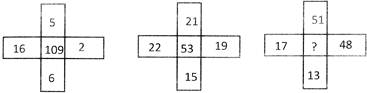
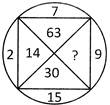
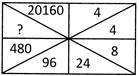
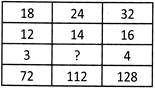
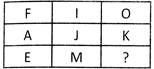
    Inserting the Missing Number In this chapter questions contain a figure, a set of figures, an arrangement or a matrix, each of which bears certain characters, be it numbers, letters or group/combination of Setters numbers which follow a particular pattern. You are required to identify and decipher this pattern and accordingly find the missing character in the figure.   Example: No. (1 to 6)   Direction: Find the missing character from among the given alternatives.   1.                    (a) 45                            (b) 35 (c) 25                            (d) 15 (e) None of these Ans.     (c) Explanation: The pattern is \[\to \text{ }{{\left( 16\text{ }-\text{ }6 \right)}^{2}}+\text{ }{{\left( 5\text{ }-\text{ }2 \right)}^{2}}=\text{ }100\text{ }+\text{ }9\text{ }=\text{ }109\]  \[\to \,\,\,{{\left( 22\text{ }-\text{ }15 \right)}^{2}}+\text{ }{{\left( 21\text{ }-\text{ }19 \right)}^{2}}=\text{ }49\text{ }+\text{ }4\text{ }=\text{ }53\]  \[\to \,\,\,{{\left( 17\text{ }-\text{ }13 \right)}^{2}}+\text{ }{{\left( 51\text{ }-\text{ }48 \right)}^{2}}=\text{ }16\text{ }+\text{ }9\text{ }=\text{ }\]   2.                                 (a) 50                            (b) 39 (c) 26                            (d) 1 (e) None of these Ans.     (b)             Explanation: The pattern is:       \[\to \,\,\,3\,\times \,2-1=5\]                                                             \[\to \,\,5\,\,\times \,\,2\,\,-\,\,2\,\,=\,\,8\]                                                             \[\to \,\,8\,\,\times \,\,2\,\,-\,\,3\,\,=\,\,13\]                                                             \[\to 13\,\,\times \,\,2\,\,-\,\,4\,\,=\,\,22\]                                                      So, \[So,\,\,\,\to \,\,\,22\,\,\times \,\,2\,\,-\,\,5\,\,=\,\,39\] 3.             (a) 18                            (b) 36 (c) 135                          (d) 175 (e) None of these Ans.     (c)             Explanation: The pattern is:       \[15\times \,2=30\]                                                             \[2\,\,\times \,\,7\,\,=\,\,63\]             So, the missing number is:            \[9\times 15=135.\] 4.                            (a) 860                          (b) 1140 (c) 2880                         (d) 3240 (e) None of these Ans.     (c)             Explanation: Clearly, moving clockwise, we observe the following pattern:             \[4\times 1=4;\text{ }4\times 2=8;\text{ }8\times 3=24;\text{ }24\times 4=96;\text{ }96\times 5=480\]             So required number = \[\left( 480\times 6 \right)=2880\]             Hence, the answer is (c).   5.                         (a) 5                              (b) 4 (c) 3                              (d) 2 (e) None of these Ans.     (c)             Explanation: In the first column, \[12\,\,\times \,\,(18\,\,\div \,\,3)\,\,=\,\,72\]             In the third column, \[16\,\,\times \,\,(32\,\,\div \,\,4)\,\,=\,\,128\]             Let the missing number be x. Then, in the second column, we have             \[14\times \left( 24\text{ }\div \text{ }x \right)\text{ }=112\text{ }\Rightarrow \text{ }24\div x\,=8\text{ }\Rightarrow \,\text{ }x=3\]             Hence, the answer is (c).   6.                          (a) P                             (b) R (c) S                              (d) V (e) None of these Ans.     (b).             Explanation: Putting \[A\,\,=\,\,1,\,\,B\,\,=\,\,2,\,\,C\,\,=\,\,3,\,\,........,\,\,M\,\,=\,\,13,.......,\,\,X\,\,=\,\,24,\,\,Y\,\,=\,\,25,\,\,Z\,\,=\,\,26,\]             we have:             In the first row, \[F\,\,+\,\,I\,\,=\,\,6\,\,+\,\,9\,\,=\,\,15\,\,=\,\,O\]             In the second row, \[A\,\,+\,\,J\,\,=\,\,1\,\,+\,\,10\,\,=\,\,11\,\,=\,\,K\]             So, in the third row, missing letter \[=E\,\,+\,\,M\,\,=\,\,5\,\,+\,\,13\,\,=\,\,18\,\,=\,\,R\]             Hence, the answer is (b)

    Ranking Missing Character Ranking Test In this type of questions, generally the ranks of a person both from the top and from the bottom are mentioned and the total number of persons is asked. However, sometimes this question is put in the form of a puzzle of interchanging seats by two persons.   Example:
  • Joseph ranks seventh from the top and twenty-sixth from the bottom in a class. How many students are there in the class?
  •             (a) 31                                        (b) 32             (c) 33                                        (d) 34             (e) None of these Ans.     (b)             Explanation: Clearly, the whole class consists of:             (i) 6 students who have ranks higher than Joseph;             (ii) Joseph; and             (iii) 25 students who have ranks lower than Joseph, i.e., \[\left( 6+1+25 \right)=32\] students.  
  • Daniel is fourteenth from the right end in a row of 40 boys. What is his position from the left end?
  •             (a) 24th                                     (b) 25th             (c) 26th                                     (d) 27th             (e) None of these Ans.     (d)             Explanation: Clearly, number of boys towards the left of Daniel \[=\left( 40-14 \right)=26.\]             So, Daniel is 27th from the left end. Hence, the answer is (d).  
  • In a row of boys facing the North, A is sixteenth from the left end and C is sixteenth from the right end. B, who is fourth to the right of A, is fifth to the left of C in the row. How many boys are there in the row?
  •             (a) 39                                        (b) 40             (c) 41                                        (d) 42             (e) None of these Ans.     (b)             Explanation: Clearly, according to the given conditions, there are 15 boys to the left of A, as well as to the right of C. Also, B lies between A and C such that there are 3 boys between A and B; and 4 boys between B and C.                          So number of boys in the row \[=\text{ }\left( 15+1+3+1+4+1+15 \right)=40\]                  Hence, the answer is (b).  
  • In a row of girls, Shilpi is fifth from the left and Sukriti is sixth from the right. When they exchange their positions, then Shilpi becomes thirteenth from the left. What will be Sukriti’s position from the right?
  •             (a) 7th                                       (b) 11th             (c) 14th                                     (d) 18th             (e) None of these Ans.     (c) Explanation: Shilpi’s new position is 13th from left. But it is the same as Sukriti’s earlier position which is 6th from the right.             Thus; the row consists of \[\left( 12+1+5 \right)=18\] girls.             Now, Preeti’s new position is Kamya’s earlier position which is 5th from the left             Number of girls to the right of Preeti \[=\left( 18-5 \right)=13.\]             So, Sukriti’s new position is 4th from the right.             Hence, the answer more...

      Human Geography Nature and Scope       You have already studied ‘Geography as a Discipline’ in Chapter I of the book, Fundamentals of Physical Geography (NCERT, 2006). Do you recall the contents? This chapter has broadly covered and introduced you to the nature of geography. You are also acquainted with the important branches that sprout from the body of geography. If you re-read the chapter you will be able to recall the link of human geography with the mother discipline i.e. geography. As you know geography as a field of study is integrative, empirical, and practical. Thus, the reach of geography is extensive and each and every event or phenomenon which varies over space and time can be studied geographically. How do you see the earth’s surface? Do you realise that the earth comprises two major components: nature (physical environment) and life forms including human beings? Make a list of physical and human components of your surroundings. Physical geography studies physical environment and human geography studies “the relationship between the physical/natural and the human worlds, the spatial distributions of human phenomena and how they come about, the social and economic differences between different parts of the world”.   You are already aware of the fact that the core concern of geography as a discipline is to understand the earth as home of human beings and to study all those elements which have sustained them. Thus, emphasis is on study of nature and human beings. You will realise that geography got subjected to dualism and the wide-ranging debates started whether geography as a discipline should be a law making/theorising (nomothetic) or descriptive (idiographic). Whether its subject matter should be organised and approach of the study should be regional or systematic? Whether geographical phenomena be interpreted theoretically or through historicinstitutional approach? These have been issues for intellectual exercise but finally you will appreciate that the dichotomy between physical and human is not a very valid one because nature and human are inseparable elements and should be seen holistically. It is interesting to note that both physical and human 1 Agnew J. Livingstone, David N. and Rogers, A.; (1996) Blackwell Publishing Limited, Malden, U.S.A. p. 1 and 2. 2 Fundamentals of Human Geography phenomena are described in metaphors using symbols from the human anatomy.   We often talk of the ‘face’ of the earth, ‘eye’ of the storm, ‘mouth’ of the river, ‘snout’ (nose) of the glacier, ‘neck’ of the isthmus and ‘profile’ of the soil. Similarly regions, villages, towns have been described as ‘organisms’. German geographers describe the ‘state/country’ as a ‘living organism’. Networks of road, railways and water ways have often been described as “arteries of circulation”. Can you collect such terms and expressions from your own language? The basic questions now arises, can we separate nature and human when they are so intricately intertwined?   Human more...

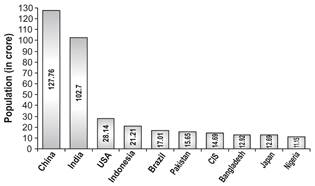
      The World Population (Distribution, Density and Growth)   The people of a country are its real wealth. It is they who make use of the country’s resources and decide its policies. Ultimately a country is known by its people.   It is important to know how many women and men a country has, how many children are born each year, how many people die and how? Whether they live in cities or villages, can they read or write and what work do they do? These are what you will study about in this unit.   The world at the beginning of 21st century recorded the presence of over 6 billion population. We shall discuss the patterns of their distribution and density here.   Why do people prefer to live in certain regions and not in others?   The population of the world is unevenly distributed. The remark of George B. Cressey about the population of Asia that “Asia has many places where people are few and few place where people are very many” is true about the pattern of population distribution of the world also.   PATTERNS OF POPULATION DISTRIBUTION IN THE WORLD   Patterns of population distribution and density help us to understand the demographic characteristics of any area. The term population distribution refers to the way people are spaced over the earth’s surface. Broadly, 90 per cent of the world population lives in about 10 per cent of its land area. The 10 most populous countries of the world contribute about 60 per cent of the world’s population. Of these 10 countries, 6 are located in Asia. Identify these six countries of Asia.                         Fig. 2.1: Most Populous Countries     DENSITY OF POPULATION Each unit of land has limited capacity to support people living on it. Hence, it is necessary to understand the ratio between the numbers of people to the size of land. This ratio is the density of population. It is usually measured in persons per sq. km Population \[Density\text{ }of\text{ }Population\text{ }=\frac{Population}{Area}\] For example, area of Region X is 100 sq. km and the population is 1,50,000 persons. The density of population is calculated as: \[Density\,\,=\,\,\frac{1,50,000}{100}\] = 1,500 person/sq. km   What does this tell you about Region X?   Look at the map given below:   Do you observe that some areas are really crowded? These are the densely populated parts of the world with more than 200 persons on every sq. km. These are the North –Eastern part of U.S.A., North-Western part of Europe, South, South-East and East Asia.   Other areas like those near the North and South Poles, the hot and the cold deserts and high rainfall zones near the Equator have very low density of population. These are the sparsely populated regions of the world with less than 01 person per sq. km. more...
      Population Composition   People of any country are diverse in many respects. Each person is unique in her/his own way. People can be distinguished by their age, sex and their place of residence. Some of the other distinguishing attributes of the population are occupation, education and life expectancy.   SEX COMPOSITION The number of women and men in a country is an important demographic characteristic. The ratio between the number of women and men in the population is called the Sex Ratio. In some countries it is calculated by using the formula:   \[\frac{Male\,\,Population}{Female\,\,Population}\times 1000\] or the number of males per thousand females.   In India, the sex ratio is worked out using the formula:   \[\frac{Female\,\,Population}{Male\,\,Population}\times 1000\] or the number of females per thousand males.   The sex ratio is an important information about the status of women in a country.   In regions where gender discrimination is rampant, the sex ratio is bound to be unfavourable to women. Such areas are those where the practice of female foeticide, female infanticide and domestic violence against women are prevalent. One of the reasons could be lower socio-economic status of women in these areas. You must remember that more women in the population does not mean they have a better status. It could be that the men might have migrated to other areas for employment.   Natural Advantage v/s Social Disadvantage Females have a biological advantage over males as they tend to be more resilient than males yet this advantage is cancelled out by the social disadvantages and discriminations that they face.   On an average, the world population reflects a sex ratio of 990 females per 1000 males. The highest sex ratio in the world has been recorded in Latvia which is 1187 females per 1000 males. In contrast, the lowest sex ratio occurs in U.A.E. which is 468 females per 1000 males.   The world pattern of sex ratio does not exhibit variations in the developed regions of the world. The sex ratio is favourable for females in 139 countries of the world and unfavourable for them in the remaining 72 countries listed by the United Nations.   In general, Asia has a low sex ratio. Countries like China, India, Saudi Arabia, Pakistan, Afghanistan have a lower sex ratio. On the other extreme is greater part of Europe (including Russia) where males are in minority. A deficit of males in the populations of many European countries is attributed to better status of women, and an excessively male-dominated out-migration to different parts of the world in the past.   Age Structure Age structure represents the number of people of different age groups. This is an important indicator of population composition, since a large size of population in the age group of 15- 59 indicates a large working population. A greater proportion of population above 60 years represents an ageing population which requires more expenditure on health care facilities. Similarly high proportion more...

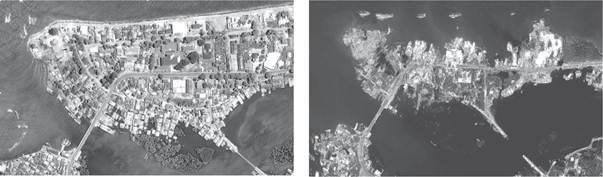
      Human Development   The words ‘growth’ and ‘development’ are not new to you. Look around you, almost everything that you can see (and many that you cannot) grows and develops. These may be plants, cities, ideas, nations, relationships or even you yourself! What does this mean?   Do growth and development mean the same thing? Do they accompany each other?   This chapter discusses the concept of human development as it pertains to nations and communities.   GROWTH AND DEVELOPMENT Both growth and development refer to changes over a period of time. The difference is that growth is quantitative and value neutral. It may have a positive or a negative sign. This means that the change may be either positive (showing an increase) or negative (indicating a decrease).   Development means a qualitative change which is always value positive. This means that development cannot take place unless there is an increment or addition to the existing conditions. Development occurs when positive growth takes place. Yet, positive growth does not always lead to development. Development occurs when there is a positive change in quality.   For example, if the population of a city grows from one lakh to two lakhs over a period of time, we say the city has grown. However, if a facilities like housing, provision of basic services and other characteristics remain the same, then this growth has not been accompanied by development.   Can you think of a few more examples to differentiate between growth and development?             Activity Write a short essay or draw a set of pictures illustrating growth without development and growth with development.   For many decades, a country’s level of development was measured only in terms of its economic growth.     Band Aceh, June, 2004                                       Band Aceh, December, 2004 Do you know that cities can also grow negatively? Look at the photographs of this tsunami affected city. Are natural disasters the only reasons for negative growth in a city’s size?   This meant that the bigger the economy of the country, the more developed it was considered, even though this growth did not really mean much change in the lives of most people.   The idea that the quality of life people enjoy in a country, the opportunities they have and freedoms they enjoy, are important aspects of development, is not new.   These ideas were clearly spelt out for the first time in the late eighties and early nineties. The works of two South Asian economists, Mahbub-ul-Haq and Amartya Sen are important in this regard.   The concept of human development was introduced by Dr. Mahbub-ul-Haq. Dr. Haq has described human development as development that enlarges people’s choices and improves their lives. People are central to all development under this concept. These choices are not fixed but keep on changing. The basic goal of development is to create conditions where people can live more...

    You need to login to perform this action.
    You will be redirected in 3 sec spinner

    Instruments Measurements
    Ammeter Electric current
    Anemometer Wind (speed and velocity)
    Altimeter Altitudes
    Audiometer Difference of hearing
    Barometer Atmospheric pressure
    Dynamometer Electric power
    Fathometer Depth of ocean
    Galvanometer Relative current
    Hygrometer Relative humidity
    Micrometer Small distance and Angles
    Pyrometer High temperature
    Pyrheliometer Solar Radiation
    Pyknometer Density
    Planimeter Area of plane surface
    Quadrant Altitude
    Radio Micrometer Heat Radiations
    Rain Guage Rainfall
    Refractometer Refractive index
    Spring Balance Weight of a body
    Spectrometer Refractive index
    Spectroscope Spectrum analysis
    Sextant Angular distance
    Salinometer Density of salt solution
    Seismometer Earthquakes