International Trade
You have already studied about the various aspects of International trade in the book Fundamentals of Human Geography. International Trade is mutually beneficial as no country is self-sufficient. India’s International trade has undergone a sea change in recent years in terms of volume, composition as well as direction. Although India’s contribution in the world trade is as low as one per cent of the total volume, yet it plays a significant role in the world economy.
Let us examine the changing pattern of India’s International trade. In 1950-51, India’s external trade was worth Rs. 1,2140 million, which rose to Rs. 8,37, 1330 million in 2004 - 05. Can you calculate the percentage growth in 2004-2005 over 1950-51? There are numerous reasons for this sharp rise in overseas trade, such as, the momentum picked up by the manufacturing sectors, the liberal policies of the government and the diversification of markets.
The nature of India’s foreign trade has changed over the years (Table 11.1). Though there has been an increase in the total volume of import and export, the value of import continued to be higher than that of exports. There has also been an increase in trade deficit over the last couple of years. This increase in deficit is attributed to the price rise of crude petroleum which forms a major component of India’s import list.
Changing Pattern of the Composition of India’s Exports
Table 11.1 India’s Foreign Trade
(in Million Rs.)
Geographical Perspective on Selected Issues and Problems
Environmental Pollution
Environmental pollution results from ‘the release of substances and energy from waste products of human activities. There are many types of pollution. They are classified on the basis of medium through which pollutants are transported and diffused. Pollution can be classified into (i) air pollution, (ii) water pollution, (iii) land pollution and (iv) noise pollution.
Water Pollution
Indiscriminate use of water by increasing population and industrial expansion has led degradation of the quality of water considerably. Surface water available from rivers, canals, lakes, etc. is never pure. It contains small quantities of suspended particles, organic and inorganic substances. When concentration of these substances increases, the water becomes polluted, and hence becomes unfit for use. In such a situation, the self-purifying capacity of water is unable to purify the water.
Fig.12.1: Cutting Through Effluent: Rowing through a pervasive layer of foam on the heavily polluted Yamuna on the outskirts of New Delhi
Though water pollutants are also created from natural sources (erosion, landslides, decay and decomposition of plants and animals, etc.) pollutants from human sources are the real causes of concern. Human beings pollute the water through industrial, agricultural and cultural activities. Among these activities, industry is the most significant contributor.
Table 12.1: Types and Sources of Pollution
Pollution Types
Pollution Involved
Sources of Pollution
Air Pollution
Oxides of sulphur \[\left( S{{O}_{2}}, S{{O}_{3}} \right)\] Oxides of nitrogen, carbon monoxide, hydro-carbon, ammonia, lead, aldehydes asbestos and beryllium
Combustion of coal, petrol and diesel, industrial processes, solid waste disposal, sewage disposal, etc.
Water Pollution
Odour, dissolved and suspended solids, ammonia and urea, nitrate and nitrites, chloride, fluoride, carbonates, oil and grease, insecticide and pesticide residue, tannin, coliform MPM (bacterial count) sulphates and sulphides, heavy metals e.g. lead, aresenic, mercury, manganese, etc., radioactive substances.
Human Geography Nature and Scope
You have already studied ‘Geography as a Discipline’ in Chapter I of the book, Fundamentals of Physical Geography (NCERT, 2006). Do you recall the contents? This chapter has broadly covered and introduced you to the nature of geography. You are also acquainted with the important branches that sprout from the body of geography. If you re-read the chapter you will be able to recall the link of human geography with the mother discipline i.e. geography. As you know geography as a field of study is integrative, empirical, and practical. Thus, the reach of geography is extensive and each and every event or phenomenon which varies over space and time can be studied geographically. How do you see the earth’s surface? Do you realise that the earth comprises two major components: nature (physical environment) and life forms including human beings? Make a list of physical and human components of your surroundings. Physical geography studies physical environment and human geography studies “the relationship between the physical/natural and the human worlds, the spatial distributions of human phenomena and how they come about, the social and economic differences between different parts of the world”.
You are already aware of the fact that the core concern of geography as a discipline is to understand the earth as home of human beings and to study all those elements which have sustained them. Thus, emphasis is on study of nature and human beings. You will realise that geography got subjected to dualism and the wide-ranging debates started whether geography as a discipline should be a law making/theorising (nomothetic) or descriptive (idiographic). Whether its subject matter should be organised and approach of the study should be regional or systematic? Whether geographical phenomena be interpreted theoretically or through historicinstitutional approach? These have been issues for intellectual exercise but finally you will appreciate that the dichotomy between physical and human is not a very valid one because nature and human are inseparable elements and should be seen holistically. It is interesting to note that both physical and human 1 Agnew J. Livingstone, David N. and Rogers, A.; (1996) Blackwell Publishing Limited, Malden, U.S.A. p. 1 and 2. 2 Fundamentals of Human Geography phenomena are described in metaphors using symbols from the human anatomy.
We often talk of the ‘face’ of the earth, ‘eye’ of the storm, ‘mouth’ of the river, ‘snout’ (nose) of the glacier, ‘neck’ of the isthmus and ‘profile’ of the soil. Similarly regions, villages, towns have been described as ‘organisms’. German geographers describe the ‘state/country’ as a ‘living organism’. Networks of road, railways and water ways have often been described as “arteries of circulation”. Can you collect such terms and expressions from your own language? The basic questions now arises, can we separate nature and human when they are so intricately intertwined?
Human more...
The World Population(Distribution, Density and Growth)
The people of a country are its real wealth. It is they who make use of the country’s resources and decide its policies. Ultimately a country is known by its people.
It is important to know how many women and men a country has, how many children are born each year, how many people die and how? Whether they live in cities or villages, can they read or write and what work do they do? These are what you will study about in this unit.
The world at the beginning of 21st century recorded the presence of over 6 billion population. We shall discuss the patterns of their distribution and density here.
Why do people prefer to live in certain regions and not in others?
The population of the world is unevenly distributed. The remark of George B. Cressey about the population of Asia that “Asia has many places where people are few and few place where people are very many” is true about the pattern of population distribution of the world also.
PATTERNS OF POPULATION
DISTRIBUTION IN THE WORLD
Patterns of population distribution and density help us to understand the demographic characteristics of any area. The term population distribution refers to the way people are spaced over the earth’s surface. Broadly, 90 per cent of the world population lives in about 10 per cent of its land area.
The 10 most populous countries of the world contribute about 60 per cent of the world’s population. Of these 10 countries, 6 are located in Asia. Identify these six countries of Asia.
Fig. 2.1: Most Populous Countries
DENSITY OF POPULATION
Each unit of land has limited capacity to support people living on it. Hence, it is necessary to understand the ratio between the numbers of people to the size of land. This ratio is the density of population. It is usually measured in persons per sq. km
Population
\[Density\text{ }of\text{ }Population\text{ }=\frac{Population}{Area}\]
For example, area of Region X is 100 sq. km and the population is 1,50,000 persons. The density of population is calculated as:
\[Density\,\,=\,\,\frac{1,50,000}{100}\]
= 1,500 person/sq. km
What does this tell you about Region X?
Look at the map given below:
Do you observe that some areas are really crowded? These are the densely populated parts of the world with more than 200 persons on every sq. km. These are the North –Eastern part of U.S.A., North-Western part of Europe, South, South-East and East Asia.
Other areas like those near the North and South Poles, the hot and the cold deserts and high rainfall zones near the Equator have very low density of population. These are the sparsely populated regions of the world with less than 01 person per sq. km. more...
Population Composition
People of any country are diverse in many respects. Each person is unique in her/his own way. People can be distinguished by their age, sex and their place of residence. Some of the other distinguishing attributes of the population are occupation, education and life expectancy.
SEX COMPOSITION
The number of women and men in a country is an important demographic characteristic. The ratio between the number of women and men in the population is called the Sex Ratio. In some countries it is calculated by using the formula:
\[\frac{Male\,\,Population}{Female\,\,Population}\times 1000\]
or the number of males per thousand females.
In India, the sex ratio is worked out using the formula:
\[\frac{Female\,\,Population}{Male\,\,Population}\times 1000\]
or the number of females per thousand males.
The sex ratio is an important information about the status of women in a country.
In regions where gender discrimination is rampant, the sex ratio is bound to be unfavourable to women. Such areas are those where the practice of female foeticide, female infanticide and domestic violence against women are prevalent. One of the reasons could be lower socio-economic status of women in these areas. You must remember that more women in the population does not mean they have a better status. It could be that the men might have migrated to other areas for employment.
Natural Advantage v/s Social Disadvantage
Females have a biological advantage over males as they tend to be more resilient than males yet this advantage is cancelled out by the social disadvantages and discriminations that they face.
On an average, the world population reflects a sex ratio of 990 females per 1000 males. The highest sex ratio in the world has been recorded in Latvia which is 1187 females per 1000 males. In contrast, the lowest sex ratio occurs in U.A.E. which is 468 females per 1000 males.
The world pattern of sex ratio does not exhibit variations in the developed regions of the world. The sex ratio is favourable for females in 139 countries of the world and unfavourable for them in the remaining 72 countries listed by the United Nations.
In general, Asia has a low sex ratio. Countries like China, India, Saudi Arabia, Pakistan, Afghanistan have a lower sex ratio. On the other extreme is greater part of Europe (including Russia) where males are in minority. A deficit of males in the populations of many European countries is attributed to better status of women, and an excessively male-dominated out-migration to different parts of the world in the past.
Age Structure
Age structure represents the number of people of different age groups. This is an important indicator of population composition, since a large size of population in the age group of 15- 59 indicates a large working population. A greater proportion of population above 60 years represents an ageing population which requires more expenditure on health care facilities. Similarly high proportion more...
Human Development
The words ‘growth’ and ‘development’ are not new to you. Look around you, almost everything that you can see (and many that you cannot) grows and develops. These may be plants, cities, ideas, nations, relationships or even you yourself! What does this mean?
Do growth and development mean the same thing?
Do they accompany each other?
This chapter discusses the concept of human development as it pertains to nations and communities.
GROWTH AND DEVELOPMENT
Both growth and development refer to changes over a period of time. The difference is that growth is quantitative and value neutral. It may have a positive or a negative sign. This means that the change may be either positive (showing an increase) or negative (indicating a decrease).
Development means a qualitative change which is always value positive. This means that development cannot take place unless there is an increment or addition to the existing conditions. Development occurs when positive growth takes place. Yet, positive growth does not always lead to development. Development occurs when there is a positive change in quality.
For example, if the population of a city grows from one lakh to two lakhs over a period of time, we say the city has grown. However, if a facilities like housing, provision of basic services and other characteristics remain the same, then this growth has not been accompanied by development.
Can you think of a few more examples to differentiate between growth and development?
Activity
Write a short essay or draw a set of pictures illustrating growth without development and growth with development.
For many decades, a country’s level of development was measured only in terms of its economic growth.
Band Aceh, June, 2004 Band Aceh, December, 2004
Do you know that cities can also grow negatively? Look at the photographs of this tsunami affected city. Are natural disasters the only reasons for negative growth in a city’s size?
This meant that the bigger the economy of the country, the more developed it was considered, even though this growth did not really mean much change in the lives of most people.
The idea that the quality of life people enjoy in a country, the opportunities they have and freedoms they enjoy, are important aspects of development, is not new.
These ideas were clearly spelt out for the first time in the late eighties and early nineties. The works of two South Asian economists, Mahbub-ul-Haq and Amartya Sen are important in this regard.
The concept of human development was introduced by Dr. Mahbub-ul-Haq. Dr. Haq has described human development as development that enlarges people’s choices and improves their lives. People are central to all development under this concept. These choices are not fixed but keep on changing. The basic goal of development is to create conditions where people can live more...
Primary Activities
Human activities which generate income are known as economic activities. Economic activities are broadly grouped into primary, secondary, tertiary and quaternary activities. Primary activities are directly dependent on environment as these refer to utilisation of earth’s resources such as land, water, vegetation, building materials and minerals. It, thus includes, hunting and gathering, pastoral activities, fishing, forestry, agriculture, and mining and quarrying.
Why inhabitants of coastal and plain regions are engaged in fishing and agriculture respectively? What are the physical and social factors which affect the type of primary activities in different regions?
People engaged in primary activities are called redcollar workers due to the outdoor nature of their work.
HUNTING AND GATHERING
The earliest human beings depended on their immediate environment for their sustenance. They subsisted on: (a) animals which they hunted; and (b) the edible plants which they gathered from forests in the vicinity.
Primitive societies depended on wild animals. People located in very cold and extremely hot climates survived on hunting. The people in the coastal areas still catch fish though fishing has experienced modernisation due to technological progress. Many species, now have become extinct or endangered due to illegal hunting (poaching). The early hunters used primitive tools made of stones, twigs or arrows so the number of animals killed was limited. Why has hunting been banned in India?
Gathering and hunting are the oldest economic activity known. These are carried out at different levels with different orientations.
Gathering is practised in regions with harsh climatic conditions. It often involves primitive societies, who extract, both plants and 32 Fundamentals of Human Geography animals to satisfy their needs for food, shelter and clothing. This type of activity requires a small amount of capital investment and operates at very low level of technology. The yield per person is very low and little or no surplus is produced.
Fig. 5.1: Women Gathering Oranges in Mizoram
Gathering is practised in: (i) high latitude zones which include northern Canada, northern Eurasia and southern Chile; (ii) Low latitude zones such as the Amazon Basin, tropical Africa, Northern fringe of Australia and the interior parts of Southeast Asia (Fig. 5.2).
In modern times some gathering is market oriented and has become commercial. Gatherers collect valuable plants such as leaves, barks of trees and medicinal plants and after simple processing sell the products in the market. They use various parts of the plants, for example, the bark is used for quinine, tanin extract and cork - leaves supply materials for beverages, drugs, cosmetics, fibres, thatch and fabrics; nuts for food and oils and tree trunk yield rubber, balata, gums and resins.
Do You Know
The name of the part of the chewing gum after the flavour is gone? It is called Chicle - it is made from the milky juice of zapota tree. Gathering has little more...
Secondary Activities
All economic activities namely primary, secondary, tertiary and quaternary, revolve around obtaining and utilising resources necessary for survival.
Secondary activities add value to natural resources by transforming raw materials into valuable products. Cotton in the boll has limited use but after it is transformed into yarn, becomes more valuable and can be used for making clothes. Iron ore, cannot be used; directly from the mines, but after being converted into steel it gets its value and can be used for making many valuable machines, tools, etc. The same is true of most of the materials from the farm, forest, mine and the sea. Secondary activities, therefore, are concerned with manufacturing, processing and construction (infrastructure) industries.
MANUFACTURING
Manufacturing involves a full array of production from handicrafts to moulding iron and steel and stamping out plastic toys to assembling delicate computer components or space vehicles. In each of these processes, the common characteristics are the application of power, mass production of identical products and specialised labour in factory settings for the production of standardised commodities. Manufacturing may be done with modern power and machinery or it may still be very primitive. Most of the Third World countries still ‘manufacture’ in the literal sense of the term. It is difficult to present a full picture of all the manufacturers in these countries. More emphasis is given to the kind of ‘industrial’ activity which involves less complicated systems of production.
Characteristics of Modern Large Scale Manufacturing
Modern large scale manufacturing has the following characteristics:
Specialisation of Skills/Methods of Production
Under the ‘craft’ method factories produce only a few pieces which are made-to-order. So the costs are high. On the other hand, mass 46 Fundamentals of Human Geography production involves production of large quantities of standardised parts by each worker performing only one task repeatedly.
‘Manufacturing’ Industry and ‘Manufacturing Industry’
Manufacturing literally means ‘to make by hand’. However, now it includes goods ‘made by machines’. It is essentially a process which involves transforming raw materials into finished goods of higher value for sale in local or distant markets. Conceptually, an industry is a geographically located manufacturing unit maintaining books of accounts and, records under a management system. As the term industry is comprehensive, it is also used as synonymous with ‘manufacturing’ When one uses terms like ‘steel industry’ and ‘chemical industry’ one thinks of factories and processes. But there are many secondary activities which are not carried on in factories such as what is now called the ‘entertainment industry’ and Tourism industry, etc. So for clarity the longer expression ‘manufacturing industry’ is used.
Mechanisation
Mechanisation refers to using gadgets which accomplish tasks. Automation (without aid of human thinking during the manufacturing process) is the advanced stage of mechanisation. Automatic factories with feedback and closedloop computer control systems where machines are developed to ‘think’, have sprung up all over the world.
Technological Innovation
Technological innovations through research more...
To understand relations and functions let's consider two sets A = {1, 2, 3, 4} and B ={2,3}
Now, \[~A\times B=\{1,\,2,\,3,\,4,\}\times \{2,3\}=\{(1,\,2),\,(2,\,2),\,(3,\,2),\,(4,\,2),\,(1,\,3),\,(2,\,3),\,(3,\,3),\,(4,\,3)\}\]
Let we choose an arbitrary set:
R = [(1, 2), (2, 2), (1, 3), (4, 3)]
Then R is said to be the relation between a set A to B.
Definition: Relation R is the subset of the Cartesian product\[A\times B\]. It is represented as
\[R=\{(x,\,y):x\in A\,\,\,and\,\,\,y\in B\}\]
Note: the 2nd element in the ordered pair (x, y) is the image of 1st element Sometime, it is said that a relation on the set A means the all members / elements of the relation R be the elements / members of\[A\times A\].
Solved Example
Let \[A=\{1,\,2,\,3\}\] and a relation R is defined as \[R=\{(x,\,y):x<y\,\,where\,\,x,\,\,y\in A\}\]
Sol. \[\because A=\{1,\,2,\,3\}\]
\[A\times A=\{(1,\,1),\,(2,\,2),\,(3,\,3),\,(2,\,1),\,(3,\,1),\,(1,\,2)\,(3,\,2),\,(1,\,3),\,(2,\,3)\}\]
\[\because \,\,\,\,\,\,\,x<y\]
\[\therefore \,\,\,\,\,\,\,R=\{(x,\,y):x<y,\,\,and\,\,x,\,y\in A\}=\{(1,\,2),\,(2,\,3),\,(1,\,3)\}.\]
Note: Let a set A has m elements and set B has n elements. Then \[n(A\times B)\] be \[m\times n\] elements so, total no. of relation from A to B or between A and B be\[{{2}^{m\,\,\times \,\,n}}\].
A relation can be represented algebraically either by Roster method or set builder method.
Types of relations
(i) Void Relation: A relation R on a set be said to be void or empty relation, if no element of A is related to any elements A.
e.g A relation on set A = {1, 2, 3, 4} defined as
\[R=\{(x,y):x+y=8\}.\]
It is void relation on A because, sum of any two element of \[A\times A\] can not be 8.
(ii) Universal relation: A relation on a set A is said to be universal relation. If each element of A is related to or associated with every element of A.
(iii) Identity Relation:- A relation \[{{l}_{x}}\{(x,\,x):x\in A\}\] an a set A is said to be identity relation on A.
(iv) Reflexive relation: A relation R on the set A is said to be the reflexive relation. If each and every element of set A is associated to itself. Hence, R is reflexive iff
\[(a,\,a)\in R\,\,\forall \,\,a\in A.\]
i.e. \[aRa\,\,\,\forall \,\,a\in A\]
(v) Symmetric relation: A relation R on a set A is said to be symmetric relation iff
\[(x,\,\,y)\in R\Rightarrow (y,\,x)\in R\,\,\forall \,\,x,\,\,y\in A.\]
i.e.\[x\,R\,y\Rightarrow y\,R\,x\,\,\forall \,\,x,\,\,y\in R\]
\[\because \,\,xRy\] is read as \[x\] is R-related to \[y\].
(vi) Antisymmetric relation: A relation which is not symmetric is said to be antisymmetric relation.
(vii) Transitive relation: Let A be any non-empty set. A relation R on set A is said to be transitive
relation R iff \[(x,\,y)\in R\] and \[(y,\,z)\in R\]
then \[(x,\,z)\in R\,\,\forall \,\,x,y,z\in R.\]
i.e. \[xRy\] and \[yRz\Rightarrow xRz\,\,\forall \,\,x,y,z\in R.\]
(viii) Equivalence Relation: A relation R on a set A is said to be an equivalence relation on A iff
(i) It is reflexive i.e. \[(x,y)\in R\,\,\forall \,\,x\in R\]
(ii) It is symmetric more...
In previous classes, we have learnt the methods to solve linear equations. Let us consider the linear equations
\[{{a}_{1}}x+{{b}_{1}}y={{c}_{1}}\] (i)
\[{{a}_{2}}x+{{b}_{2}}y={{c}_{2}}\] (ii)
We have one of the methods to solve these equation by cross multiplication method.
\[\frac{x}{{{b}_{1}}{{c}_{2}}-{{b}_{2}}{{c}_{1}}}=\frac{y}{{{c}_{1}}{{a}_{2}}-{{c}_{2}}{{a}_{1}}}=\frac{1}{{{a}_{1}}{{b}_{2}}-{{a}_{2}}{{b}_{1}}}\]
Now, we learn to solve such equations with the help of matrices and determinants.
Matrix: A matrix is a rectangular array of numbers or expressions arranged in rows and columns. It is the shorthand of mathematics. It is an operator as addition, multiplication etc. Every matrix has come into existence through the solution of linear equations.
Given linear equation can be solved by matrix method & it is written as,
AX = B
Where
Definition: It is the arrangement of things into horizontal rows and vertical column. Generally matrix is represented by [ ] (square bracket) or ( ) etc.
Generally, it is represented as, where \[A=[{{a}_{ij}}]\]
i = 1, 2, 3, ........ m
j = 1, 2, 3, ....... n.
Here subscript i denotes no. of rows.
& subscript j determines no. of columns.
& \[{{a}_{ij}}\to \] represent the position of element a in the given matrix
e.g \[A=[{{a}_{ij}}]\] & if
Order of Matrix: It is the symbol which represent that how many no. of rows and no. of columns the matrix has
In the above example
Order of matrix \[A=3\times 2\] in which 3 determine no. of row & 2 determine no. of column of given matrix.
Operation of Matrix:
(a) Addition of matrices
(b) Subtraction of matrix
(c) Multiplication of matrix
(d) Adjoint of matrix
(e) Inverse of matrixes.
Addition of Matrices: Let \[A={{[{{a}_{ij}}]}_{\,m\,\times \,n}}\] & \[B={{[{{b}_{ij}}]}_{\,m\,\times \,n}}\]be two matrices, having same order. Then A + B or B + A is a matrix whose elements be formed through corresponding addition of elements of two given matrices
Subtraction of Matrices: The subtraction of a matrix takes place in the similar manner as the addition. But \[A-B\ne B-A\] i.e. \[A-B=-\,(B-A)\]
Note: For addition or substraction operation of two or more than two matrices, the given matrices should be of the same order.
Multiplication operation: Let \[A={{[{{a}_{ij}}]}_{\,m\,\times \,k}}\] a matrix of order \[m\times k\]& \[B={{[{{b}_{ij}}]}_{\,k\,\times \,p}}\]is a matrix of order\[k\times p\]. For multiplication of two matrices, no. of columns of 1st matrix should be equal to no. of rows of 2nd matrix. Otherwise these matrices cannot be multiplied.
\[A\times B=[{{c}_{ij}}]\] be a matrix whose order will be \[mxp.\]
e.g. \[A{{\left[ \xrightarrow[5\,\,\,\,\,\,2\,\,\,\,\,\,1]{2\,\,\,\,\,\,1\,\,\,\,\,\,3} \right]}_{\,2\,\times \,3}}\] &
more...

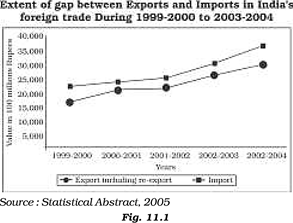 Table 11.1 India’s Foreign Trade
(in Million Rs.)
Table 11.1 India’s Foreign Trade
(in Million Rs.)
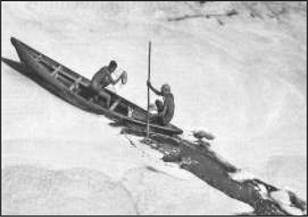 Fig.12.1: Cutting Through Effluent: Rowing through a pervasive layer of foam on the heavily polluted Yamuna on the outskirts of New Delhi
Though water pollutants are also created from natural sources (erosion, landslides, decay and decomposition of plants and animals, etc.) pollutants from human sources are the real causes of concern. Human beings pollute the water through industrial, agricultural and cultural activities. Among these activities, industry is the most significant contributor.
Table 12.1: Types and Sources of Pollution
Fig.12.1: Cutting Through Effluent: Rowing through a pervasive layer of foam on the heavily polluted Yamuna on the outskirts of New Delhi
Though water pollutants are also created from natural sources (erosion, landslides, decay and decomposition of plants and animals, etc.) pollutants from human sources are the real causes of concern. Human beings pollute the water through industrial, agricultural and cultural activities. Among these activities, industry is the most significant contributor.
Table 12.1: Types and Sources of Pollution


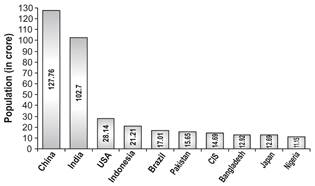 Fig. 2.1: Most Populous Countries
DENSITY OF POPULATION
Each unit of land has limited capacity to support people living on it. Hence, it is necessary to understand the ratio between the numbers of people to the size of land. This ratio is the density of population. It is usually measured in persons per sq. km
Population
\[Density\text{ }of\text{ }Population\text{ }=\frac{Population}{Area}\]
For example, area of Region X is 100 sq. km and the population is 1,50,000 persons. The density of population is calculated as:
\[Density\,\,=\,\,\frac{1,50,000}{100}\]
= 1,500 person/sq. km
What does this tell you about Region X?
Look at the map given below:
Do you observe that some areas are really crowded? These are the densely populated parts of the world with more than 200 persons on every sq. km. These are the North –Eastern part of U.S.A., North-Western part of Europe, South, South-East and East Asia.
Other areas like those near the North and South Poles, the hot and the cold deserts and high rainfall zones near the Equator have very low density of population. These are the sparsely populated regions of the world with less than 01 person per sq. km.
Fig. 2.1: Most Populous Countries
DENSITY OF POPULATION
Each unit of land has limited capacity to support people living on it. Hence, it is necessary to understand the ratio between the numbers of people to the size of land. This ratio is the density of population. It is usually measured in persons per sq. km
Population
\[Density\text{ }of\text{ }Population\text{ }=\frac{Population}{Area}\]
For example, area of Region X is 100 sq. km and the population is 1,50,000 persons. The density of population is calculated as:
\[Density\,\,=\,\,\frac{1,50,000}{100}\]
= 1,500 person/sq. km
What does this tell you about Region X?
Look at the map given below:
Do you observe that some areas are really crowded? These are the densely populated parts of the world with more than 200 persons on every sq. km. These are the North –Eastern part of U.S.A., North-Western part of Europe, South, South-East and East Asia.
Other areas like those near the North and South Poles, the hot and the cold deserts and high rainfall zones near the Equator have very low density of population. These are the sparsely populated regions of the world with less than 01 person per sq. km.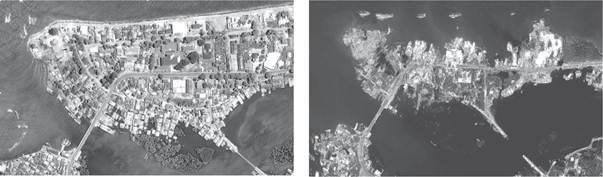 Do you know that cities can also grow negatively? Look at the photographs of this tsunami affected city. Are natural disasters the only reasons for negative growth in a city’s size?
This meant that the bigger the economy of the country, the more developed it was considered, even though this growth did not really mean much change in the lives of most people.
The idea that the quality of life people enjoy in a country, the opportunities they have and freedoms they enjoy, are important aspects of development, is not new.
These ideas were clearly spelt out for the first time in the late eighties and early nineties. The works of two South Asian economists, Mahbub-ul-Haq and Amartya Sen are important in this regard.
The concept of human development was introduced by Dr. Mahbub-ul-Haq. Dr. Haq has described human development as development that enlarges people’s choices and improves their lives. People are central to all development under this concept. These choices are not fixed but keep on changing. The basic goal of development is to create conditions where people can live
Do you know that cities can also grow negatively? Look at the photographs of this tsunami affected city. Are natural disasters the only reasons for negative growth in a city’s size?
This meant that the bigger the economy of the country, the more developed it was considered, even though this growth did not really mean much change in the lives of most people.
The idea that the quality of life people enjoy in a country, the opportunities they have and freedoms they enjoy, are important aspects of development, is not new.
These ideas were clearly spelt out for the first time in the late eighties and early nineties. The works of two South Asian economists, Mahbub-ul-Haq and Amartya Sen are important in this regard.
The concept of human development was introduced by Dr. Mahbub-ul-Haq. Dr. Haq has described human development as development that enlarges people’s choices and improves their lives. People are central to all development under this concept. These choices are not fixed but keep on changing. The basic goal of development is to create conditions where people can live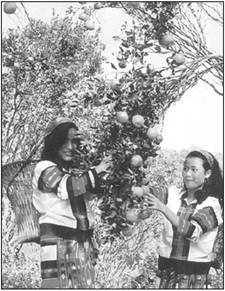 Fig. 5.1: Women Gathering Oranges in Mizoram
Gathering is practised in: (i) high latitude zones which include northern Canada, northern Eurasia and southern Chile; (ii) Low latitude zones such as the Amazon Basin, tropical Africa, Northern fringe of Australia and the interior parts of Southeast Asia (Fig. 5.2).
In modern times some gathering is market oriented and has become commercial. Gatherers collect valuable plants such as leaves, barks of trees and medicinal plants and after simple processing sell the products in the market. They use various parts of the plants, for example, the bark is used for quinine, tanin extract and cork - leaves supply materials for beverages, drugs, cosmetics, fibres, thatch and fabrics; nuts for food and oils and tree trunk yield rubber, balata, gums and resins.
Do You Know
The name of the part of the chewing gum after the flavour is gone? It is called Chicle - it is made from the milky juice of zapota tree. Gathering has little
Fig. 5.1: Women Gathering Oranges in Mizoram
Gathering is practised in: (i) high latitude zones which include northern Canada, northern Eurasia and southern Chile; (ii) Low latitude zones such as the Amazon Basin, tropical Africa, Northern fringe of Australia and the interior parts of Southeast Asia (Fig. 5.2).
In modern times some gathering is market oriented and has become commercial. Gatherers collect valuable plants such as leaves, barks of trees and medicinal plants and after simple processing sell the products in the market. They use various parts of the plants, for example, the bark is used for quinine, tanin extract and cork - leaves supply materials for beverages, drugs, cosmetics, fibres, thatch and fabrics; nuts for food and oils and tree trunk yield rubber, balata, gums and resins.
Do You Know
The name of the part of the chewing gum after the flavour is gone? It is called Chicle - it is made from the milky juice of zapota tree. Gathering has little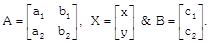




 more...