
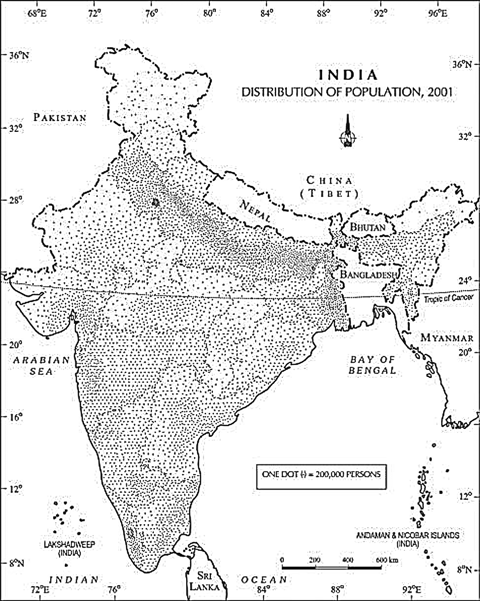
 Fig. 1.1: India - Distribution of Population
States/UTs of large size and large population
States/UTs of large size but small population
States/UTs of smaller size but larger population
Check from the table (Appendix–i) that U.P., Maharashtra, Bihar, West Bengal, Andhra Pradesh along with Tamil Nadu, Madhya Pradesh, Rajasthan, Karnataka and Gujarat, together account for about 76 per cent of the total population of the country. On the other hand, share of population is very small in the states like Jammu & Kashmir (0.98%), Arunachal Pradesh (0.11%) and Uttaranchal (0.83%) in spite of these states having fairly large geographical area.
Such an uneven spatial distribution of population in India suggests a close relationship between population and physical, socioeconomic and historical factors. As far as the physical factors are concerned, it is clear that climate along with terrain and availability of water largely determines the pattern of the population distribution. Consequently, we observe that the North Indian Plains, deltas and Coastal Plains have higher proportion of population than the interior districts of southern and central Indian States, Himalayas, some of the north eastern and the western states. However, development of irrigation (Rajasthan), availability of mineral and energy resources (Jharkhand) and development of transport network (Peninsular States) have resulted in moderate to high proportion of population in areas which were previously very thinly populated (Fig. 1.1).
Among more...
Fig. 1.1: India - Distribution of Population
States/UTs of large size and large population
States/UTs of large size but small population
States/UTs of smaller size but larger population
Check from the table (Appendix–i) that U.P., Maharashtra, Bihar, West Bengal, Andhra Pradesh along with Tamil Nadu, Madhya Pradesh, Rajasthan, Karnataka and Gujarat, together account for about 76 per cent of the total population of the country. On the other hand, share of population is very small in the states like Jammu & Kashmir (0.98%), Arunachal Pradesh (0.11%) and Uttaranchal (0.83%) in spite of these states having fairly large geographical area.
Such an uneven spatial distribution of population in India suggests a close relationship between population and physical, socioeconomic and historical factors. As far as the physical factors are concerned, it is clear that climate along with terrain and availability of water largely determines the pattern of the population distribution. Consequently, we observe that the North Indian Plains, deltas and Coastal Plains have higher proportion of population than the interior districts of southern and central Indian States, Himalayas, some of the north eastern and the western states. However, development of irrigation (Rajasthan), availability of mineral and energy resources (Jharkhand) and development of transport network (Peninsular States) have resulted in moderate to high proportion of population in areas which were previously very thinly populated (Fig. 1.1).
Among more... 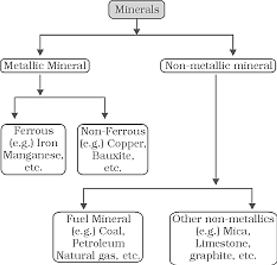 Fig. 7.1: Classification of Minerals
As, it is clear from the Fig. 7.1 metallic minerals are the sources of metals. Iron ore, copper, gold produce metal and are included in this category. Metallic minerals are further divided into ferrous and non-ferrous metallic minerals. Ferrous, as you know, refers to iron. All those minerals which have iron content are ferrous such as iron ore itself and those which do not have iron content are non-ferrous such as copper, bauxite, etc.
Non-metallic minerals are either organic in origin such as fossil fuels also known as mineral fuels which are derived from the buried animal and plant life such as coal and petroleum. Other type of non-metallic minerals are inorganic in origin such as mica, limestone and graphite, etc.
Minerals have certain characteristics. These are unevenly distributed over space. There is inverse relationship in quality and quantity of minerals i.e. good quality minerals are less in quantity as compared to low quality minerals. The third main characteristic is that all minerals are exhaustible over time. These take long to develop geologically and they cannot be replenished immediately at the time of need. Thus, they have to be conserved and not misused as they do not have the second crop.
Agencies involved in the Exploration of Minerals
In India, systematic surveying, prospecting and exploration for minerals is undertaken by the Geological Survey of India (GSI), Oil and Natural Gas Commission (ONGC), Mineral Exploration Corporation Ltd. (MECL), National Mineral Development Corporation (NMDC), Indian Bureau of Mines (IBM), Bharat Gold Mines Ltd. (BGML), Hindustan Copper Ltd. (HCL), National Aluminium Company Ltd. (NALCO) and the Departments of Mining and Geology in various states.
Distribution of Minerals in India
Most of the metallic minerals in India occur in the peninsular plateau region in the old crystalline rocks. Over 97 percent of coal reserves occur in the valleys of Damodar, Sone, Mahanadi and Godavari. Petroleum reserves are located in the sedimentary basins of Assam, more...
Fig. 7.1: Classification of Minerals
As, it is clear from the Fig. 7.1 metallic minerals are the sources of metals. Iron ore, copper, gold produce metal and are included in this category. Metallic minerals are further divided into ferrous and non-ferrous metallic minerals. Ferrous, as you know, refers to iron. All those minerals which have iron content are ferrous such as iron ore itself and those which do not have iron content are non-ferrous such as copper, bauxite, etc.
Non-metallic minerals are either organic in origin such as fossil fuels also known as mineral fuels which are derived from the buried animal and plant life such as coal and petroleum. Other type of non-metallic minerals are inorganic in origin such as mica, limestone and graphite, etc.
Minerals have certain characteristics. These are unevenly distributed over space. There is inverse relationship in quality and quantity of minerals i.e. good quality minerals are less in quantity as compared to low quality minerals. The third main characteristic is that all minerals are exhaustible over time. These take long to develop geologically and they cannot be replenished immediately at the time of need. Thus, they have to be conserved and not misused as they do not have the second crop.
Agencies involved in the Exploration of Minerals
In India, systematic surveying, prospecting and exploration for minerals is undertaken by the Geological Survey of India (GSI), Oil and Natural Gas Commission (ONGC), Mineral Exploration Corporation Ltd. (MECL), National Mineral Development Corporation (NMDC), Indian Bureau of Mines (IBM), Bharat Gold Mines Ltd. (BGML), Hindustan Copper Ltd. (HCL), National Aluminium Company Ltd. (NALCO) and the Departments of Mining and Geology in various states.
Distribution of Minerals in India
Most of the metallic minerals in India occur in the peninsular plateau region in the old crystalline rocks. Over 97 percent of coal reserves occur in the valleys of Damodar, Sone, Mahanadi and Godavari. Petroleum reserves are located in the sedimentary basins of Assam, more... 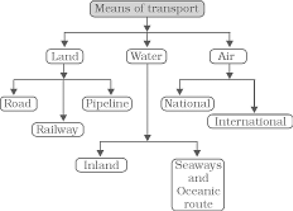 Land Transport
The pathways and unmetalled roads have been used for transportation in India since ancient times. With the economic and technological development, metalled roads and railways were developed to move large volume of goods and people from one place to another. Ropeways, cableways and pipelines were devised to cater to the demands of transporting specific goods under special circumstances.
Road Transport
India has one of the largest road networks in the world with a total length of 33.1 lakh km (2005). About 85 per cent of passenger and 70 per cent of freight traffic are carried by roads every year. Road transport is relatively suitable for shorter distance travel.
Do You Know?
Sher Shah Suri built the Shahi (Royal) road to strengthen and consolidate his empire from the Indus Valley to the Sonar Valley in Bengal. This road was renamed the Grand Trunk (GT) road during the British period, connecting Calcutta and Peshawar. At present, it extends from Amritsar to Kolkata. It is bifurcated into 2 segments: (a) National Highway (NH)-1 from Delhi to Amritsar, and (b) NH- 2 from Delhi to Kolkata.
Road transport in modern sense was very limited in India before World War-II. The first serious attempt was made in 1943 when ‘Nagpur Plan’ was drawn. This plan could not be implemented due to lack of coordination among the princely states and British India. After Independence, twenty-year road plan (1961) was introduced to improve the conditions of roads in India. However, roads continue to concentrate in and around urban centres. Rural and remote areas had the least connectivity by road.
For the purpose of construction and maintenance, roads are classified as National Highways (NH), more...
Land Transport
The pathways and unmetalled roads have been used for transportation in India since ancient times. With the economic and technological development, metalled roads and railways were developed to move large volume of goods and people from one place to another. Ropeways, cableways and pipelines were devised to cater to the demands of transporting specific goods under special circumstances.
Road Transport
India has one of the largest road networks in the world with a total length of 33.1 lakh km (2005). About 85 per cent of passenger and 70 per cent of freight traffic are carried by roads every year. Road transport is relatively suitable for shorter distance travel.
Do You Know?
Sher Shah Suri built the Shahi (Royal) road to strengthen and consolidate his empire from the Indus Valley to the Sonar Valley in Bengal. This road was renamed the Grand Trunk (GT) road during the British period, connecting Calcutta and Peshawar. At present, it extends from Amritsar to Kolkata. It is bifurcated into 2 segments: (a) National Highway (NH)-1 from Delhi to Amritsar, and (b) NH- 2 from Delhi to Kolkata.
Road transport in modern sense was very limited in India before World War-II. The first serious attempt was made in 1943 when ‘Nagpur Plan’ was drawn. This plan could not be implemented due to lack of coordination among the princely states and British India. After Independence, twenty-year road plan (1961) was introduced to improve the conditions of roads in India. However, roads continue to concentrate in and around urban centres. Rural and remote areas had the least connectivity by road.
For the purpose of construction and maintenance, roads are classified as National Highways (NH), more... 



You need to login to perform this action.
You will be redirected in
3 sec